
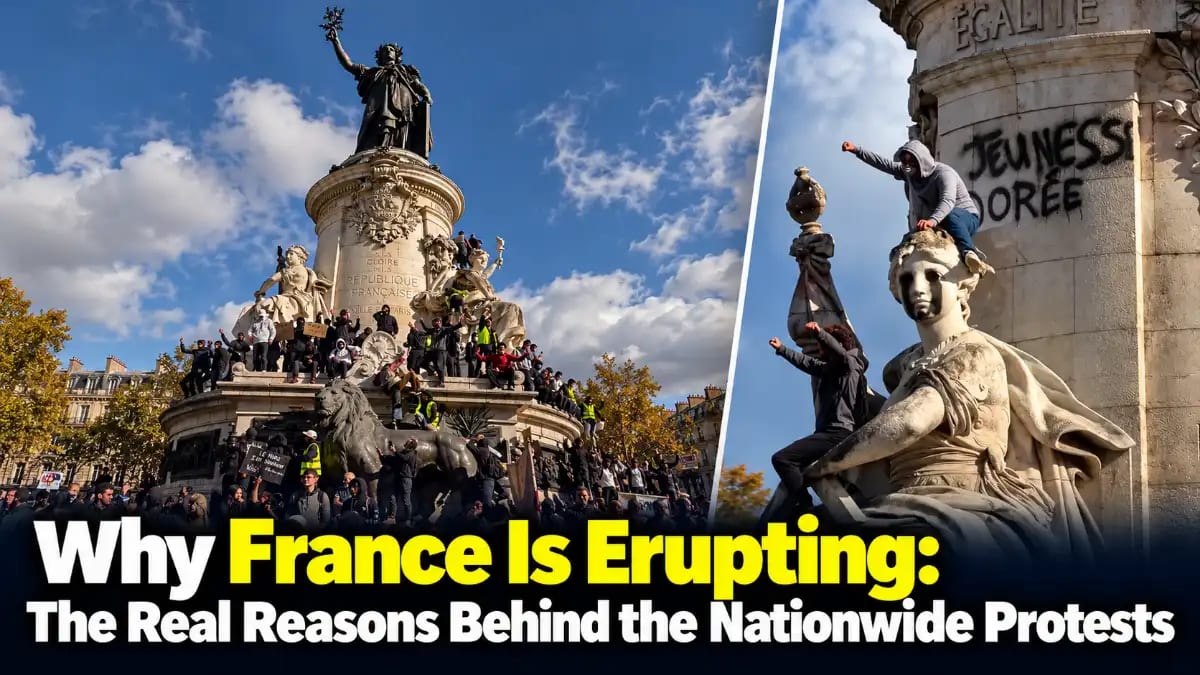

PARIS, October 18, 2026: France is dealing with the aftermath of one of its most violent waves of unrest in recent years after nationwide demonstrations over rising living costs, deteriorating public services and school conditions escalated into clashes, arson and looting on Saturday, October 17.
Reuters reported on Sunday that more than 2,000 people had been arrested and over 600 police officers injured in its later update. An earlier Reuters report cited nearly 1,800 arrests and more than 500 injured officers, illustrating how the figures changed as authorities updated their accounting. One demonstrator also died after suffering a cardiac arrest during protests in Paris; the available reporting does not establish that police action or a direct assault caused the death.
Why are people protesting in France?
The latest wave of demonstrations grew out of student protests over overcrowded classrooms, teacher shortages, deteriorating school facilities and demands for better educational resources. The mobilisation subsequently expanded, attracting workers, trade unionists, parents and other demonstrators concerned about the cost of living and pressure on public services.
Rising fuel prices and household expenses have added to public frustration. Demonstrators and unions have also raised concerns about economic inequality, social protection and proposed spending reductions. These grievances have revived comparisons with France's Yellow Vest movement, which began in 2018 amid anger over fuel taxes and purchasing power.
However, the current movement is not identical to the Yellow Vest protests. It began with education-related complaints before developing into a broader expression of dissatisfaction with economic conditions and government policies.
Clashes, looting and fires across major cities
Violence was reported in several cities, including Paris, Limoges, Marseille, Lyon and Bordeaux. In Paris, groups of masked individuals clashed with police, damaged shopfronts, set objects on fire and looted businesses.
One of the most serious incidents occurred in Limoges, where a fire set during the unrest badly damaged the historic town hall, a 19th-century building that had stood for around 143 years. In Marseille, protesters entered and defaced the city hall, while a tourist office in Lyon was also set ablaze. Shops and other properties were damaged in several locations.
Authorities deployed police to control crowds and respond to fires and property damage. Reuters reported that hundreds of thousands of people took part in demonstrations across France, although estimates differed between official figures and organisers' counts.
It is important to distinguish the wider protest movement from the violent incidents. Many demonstrators participated in peaceful marches, while separate groups were accused of arson, looting and attacks on property and police. Responsibility for individual incidents must be established through investigation.
What is the latest update as of October 18?
Arrest and injury figures changed as authorities issued updated information. Reuters' reporting on Sunday described nearly 1,800 arrests and more than 500 injured officers in an earlier account, while a later update cited more than 2,000 arrests and over 600 injured officers. These should be understood as evolving figures rather than a final nationwide total.
President Emmanuel Macron condemned the violence and said those responsible for attacks, vandalism and looting would face prosecution. He was scheduled to address the nation on Sunday evening, but the full outcome of that address could not be independently established from the reports reviewed for this article.
Government representatives blamed radical-left groups and criminal elements for the unrest. That is the government's assessment; it should not be taken as proof that every violent incident was centrally organised or that all demonstrators shared the same political objectives.
Is France facing another Yellow Vest movement?
There are similarities between the current unrest and the Yellow Vest movement of 2018, particularly anger over purchasing power, economic inequality and the perceived burden of government policy on ordinary households.
There are also important differences. The current mobilisation began with school conditions and teacher shortages before spreading to wider social and economic grievances. Students, unions, parents and other groups have participated, but they do not necessarily share identical demands or political goals.
Why the unrest matters politically
The demonstrations have increased pressure on Macron's government as France approaches the 2027 presidential election. The scale of the mobilisation, damage to public buildings and businesses, and questions about the authorities' response have intensified the political debate.
The government faces the challenge of addressing concerns over education, purchasing power and public services while restoring public order and supporting businesses affected by the violence. Local authorities have begun clean-up efforts, and officials have promised assistance for affected businesses.
The longer-term political consequences will depend on whether the government responds to demonstrators' underlying grievances, how investigations into the violence proceed and whether further protests take place.
What happens next?
Authorities are expected to continue investigating arson, looting and attacks on police and property. Businesses and local governments must also assess the damage and begin recovery work. The government has promised accountability for those responsible for criminal acts, while the broader policy concerns raised by peaceful demonstrators remain part of the national debate.
For now, France faces two connected but distinct challenges: responding to economic and public-service grievances that brought people onto the streets, and addressing violence that caused injuries, arrests and extensive property damage. The outcome could shape the political climate ahead of the 2027 presidential election.
Frequently Asked Questions
Ketan
Editor-in-ChiefPassionate journalist and digital news editor committed to delivering accurate, timely, and fact-checked news.












Comments (0)
Leave a Comment
No comments yet. Be the first to comment!