
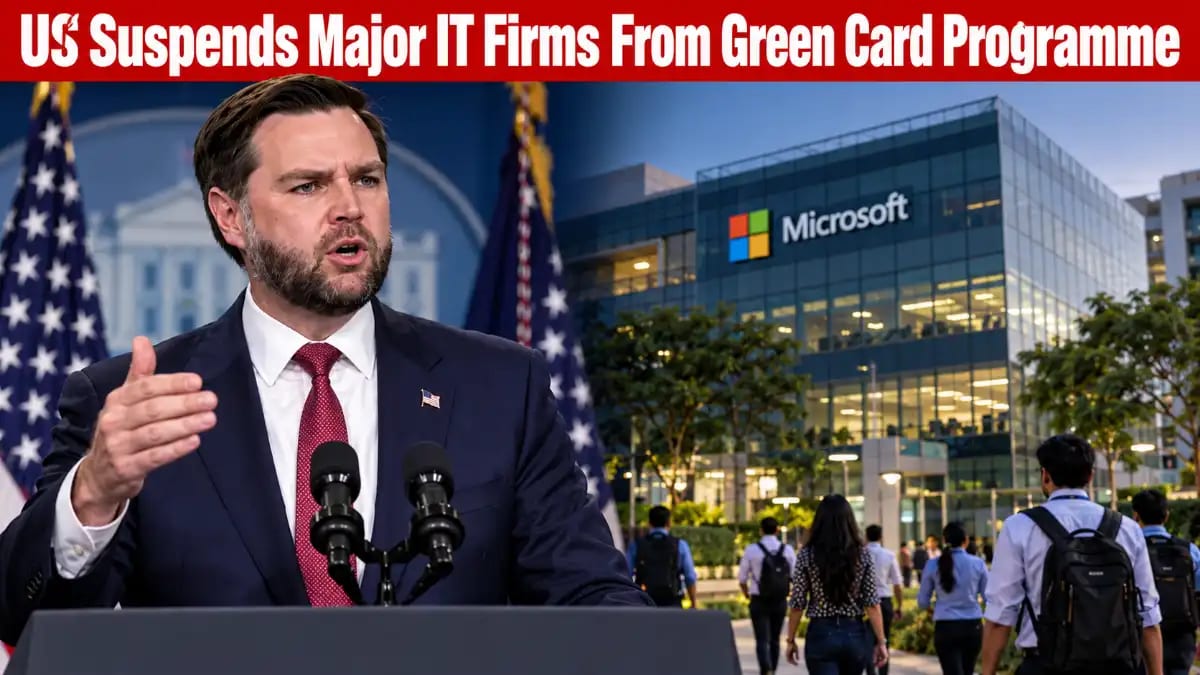

Washington has found another way to turn immigration policy into a corporate stress test. On October 8, 2026, the Trump administration announced the suspension of Microsoft, Adobe and several major IT services companies from the US Permanent Labor Certification (PERM) programme, citing alleged immigration-related fraud and concerns about American jobs. The affected firms include Infosys, Tata Consultancy Services (TCS), Wipro, HCLTech, Cognizant and Capgemini.
Vice President JD Vance argued that companies should not lay off American employees while continuing to rely on foreign-worker programmes. His message is politically straightforward: American jobs should come first. The practical consequences, however, are more complicated than a campaign slogan.
What is Washington alleging?
Vance claimed that foreign professionals and outsourcing companies can undercut American workers through lower compensation. He cited salary differences and Microsoft's workforce reductions to support the administration's case. These figures and allegations should not be treated as universally established facts: meaningful wage comparisons require evidence accounting for job responsibilities, experience, location and compensation structure.
Microsoft disputed the administration's characterisation of its immigration filings. The company said most of the H-1B filings cited involved existing employees extending or changing their status, rather than simply bringing in new workers to replace Americans. The allegations and the company's response leave the central question—whether particular hiring practices violated applicable rules—to evidence and the relevant investigations.
PERM is not the same as an H-1B visa
The distinction matters for thousands of professionals following the story. H-1B is a temporary work-visa category for eligible specialty occupations. PERM, by contrast, is a labour-certification process that is generally required for many employer-sponsored employment-based green-card cases.
Under PERM, an employer generally must demonstrate that there are insufficient available, qualified and willing US workers for the position and that employing the foreign worker will not adversely affect the wages and working conditions of similarly employed US workers. The process is meant to test the labour-market impact—not to provide a shortcut around it.
The announced suspension means the US Department of Labor will not accept new or process pending covered PERM applications involving the affected companies. It does not automatically cancel existing H-1B status or mean every affected employee must leave the country. The consequences depend on each worker's immigration status and the stage of the application.
Indian IT companies face questions, workers face uncertainty
The decision puts India's major technology-services exporters under greater scrutiny in a market that remains important to their business. Professionals relying on employer-sponsored green cards could face delays and uncertainty, while employers may need to review immigration compliance, workforce planning and alternative options for affected employees.
There is an important distinction between the political announcement and the practical impact. TCS said on October 9 that it did not expect a material impact on its workforce strategy or client engagements. It reported that its PERM applications had been in single digits over the previous two years and said it planned to hire an additional 15,000 employees in the US over five years. The impact, therefore, should not be assumed to be identical across every company or worker.
The satire behind the policy
Washington's argument is that companies must stop using immigration programmes to disadvantage American workers. That is a legitimate issue for regulators to investigate when there is evidence of wrongdoing. But suspending a green-card pathway also affects foreign professionals who may already be working legally, paying taxes and building careers in the United States.
There is a certain irony in a technology economy that recruits talent across borders, depends on international expertise and then discovers that the people behind its software need a fresh political permission slip to plan their long-term lives. The code may be global; the career uncertainty is intensely personal.
Protecting domestic workers and enforcing wage rules are legitimate policy goals. Yet a broad administrative suspension is not, by itself, proof that every affected employer committed fraud or that every foreign worker displaced an American. Investigations must establish responsibility, and enforcement should distinguish proven violations from allegations.
What happens next?
The immediate questions are how long the suspensions will remain in effect, how the Department of Labor will handle affected applications and whether the companies will challenge or otherwise respond to the measures. Workers should obtain case-specific advice from qualified US immigration counsel rather than assume their existing status has been cancelled or that their green-card process will automatically resume.
The larger debate is about how the United States balances domestic employment, fair wages and access to global talent. If the administration can demonstrate specific violations and enforce the rules fairly, it may strengthen confidence in the system. If political messaging outruns the evidence, the result could be more uncertainty for workers and employers alike.
In the end, “American jobs first” may fit neatly on a political banner. Turning it into a fair immigration policy requires something less theatrical: transparent evidence, consistent enforcement and clarity for the people whose futures depend on the outcome.
Frequently Asked Questions
Ketan
Editor-in-ChiefPassionate journalist and digital news editor committed to delivering accurate, timely, and fact-checked news.













Comments (0)
Leave a Comment
No comments yet. Be the first to comment!