
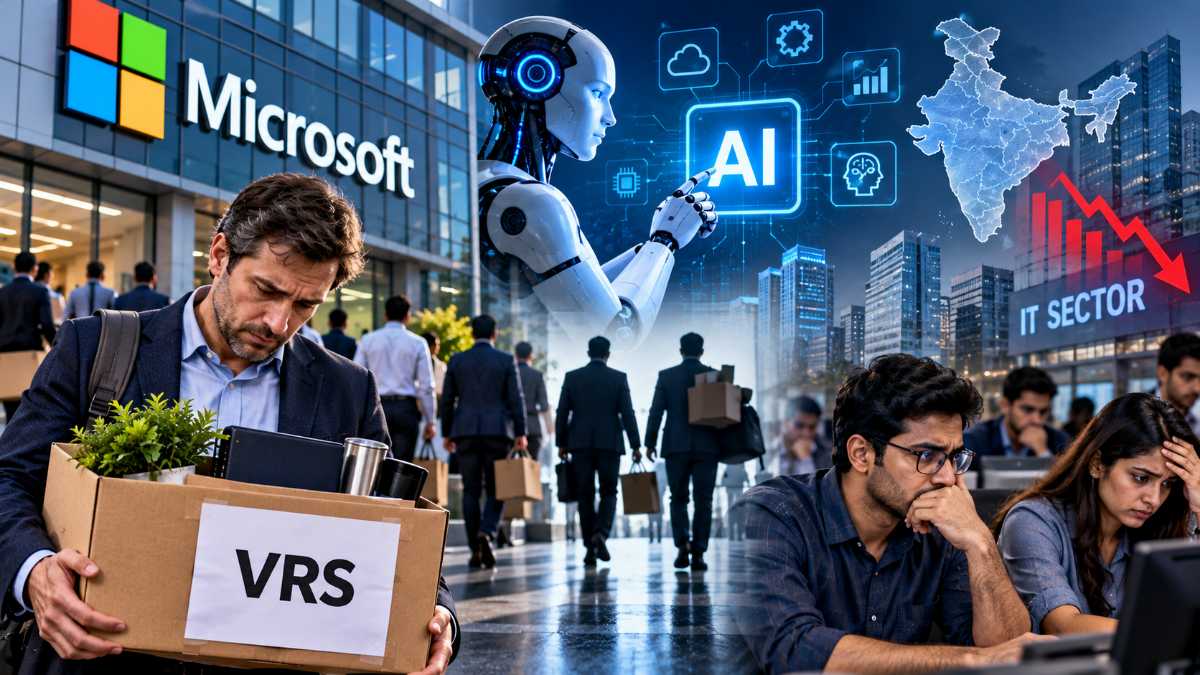

Microsoft's Strategic Workforce Realignment
Technology giant Microsoft is reportedly initiating a Voluntary Retirement Scheme (VRS) for an estimated 60,000 employees worldwide, a strategic move widely seen as a direct consequence of the company's aggressive pivot towards Artificial Intelligence (AI) integration across its operations. This substantial workforce reduction signals a profound shift in how major tech firms are adapting to the rapidly evolving AI landscape, prompting immediate concern within India's vast information technology sector.
The AI Imperative Driving Workforce Changes
The decision to offer VRS underscores a broader industry trend where AI and automation are increasingly taking over tasks traditionally performed by human employees. Sources familiar with the development indicate that Microsoft aims to streamline its operations and enhance efficiency by leveraging AI-driven solutions, particularly in areas like software development, customer support, and data analysis. This proactive restructuring is designed to align the company's human capital with its future-focused AI strategy.
"The rapid advancements in AI are fundamentally reshaping job roles and skill requirements. Companies like Microsoft are at the forefront of this transformation, making strategic decisions to remain competitive and innovative," an industry analyst commented, requesting anonymity.
Indian IT Sector Braces for Impact
The news from Microsoft has triggered significant apprehension across the Indian IT industry, a sector heavily reliant on a large human workforce for software services, BPO, and IT consulting. India, often dubbed the 'back office of the world', employs millions in its technology services sector, and any large-scale global workforce reduction by a tech behemoth like Microsoft sends a chilling signal.
Potential Ripple Effects on Indian Workforce
- Job Displacement Fears: Experts warn that if global tech leaders continue to reduce human intervention through AI, it could lead to substantial job losses in India, particularly for those in routine or process-oriented roles.
- Reskilling Urgency: The development highlights an urgent need for the Indian IT workforce to reskill and upskill in AI, machine learning, data science, and other emerging technologies to remain relevant.
- Economic Implications: A significant downturn in IT employment could have broader economic repercussions for India, given the sector's substantial contribution to GDP and employment.
The Broader Trend of Automation and AI
While Microsoft's move is prominent, it is not an isolated incident. Numerous companies globally are exploring or implementing AI to automate tasks, optimize processes, and reduce operational costs. This shift is accelerating, driven by advancements in generative AI and large language models, which are capable of performing complex cognitive tasks.
According to preliminary industry reports, the adoption of AI could potentially automate a significant percentage of current job roles across various sectors within the next decade. The IT services sector, with its emphasis on repeatable processes and code generation, is particularly vulnerable.
Preparing for the AI-Driven Future
Industry leaders and policymakers in India are now faced with the critical challenge of preparing the workforce for this AI-driven future. This includes:
- Investing heavily in AI education and training programs.
- Fostering innovation and entrepreneurship in AI-related fields.
- Developing robust social safety nets for displaced workers.
- Encouraging a culture of continuous learning and adaptability within organizations.
The Microsoft VRS serves as a stark reminder that the AI revolution is not just about technological advancement, but also about profound societal and economic transformation, demanding proactive and strategic responses from nations with large tech workforces like India.
Frequently Asked Questions
Aniket More
Senior EditorAniket More is an editorial writer and journalist for Digital Bharat Times, specializing in verified news reporting, regional developments, and national policy analysis.














Comments (0)
Leave a Comment
No comments yet. Be the first to comment!