
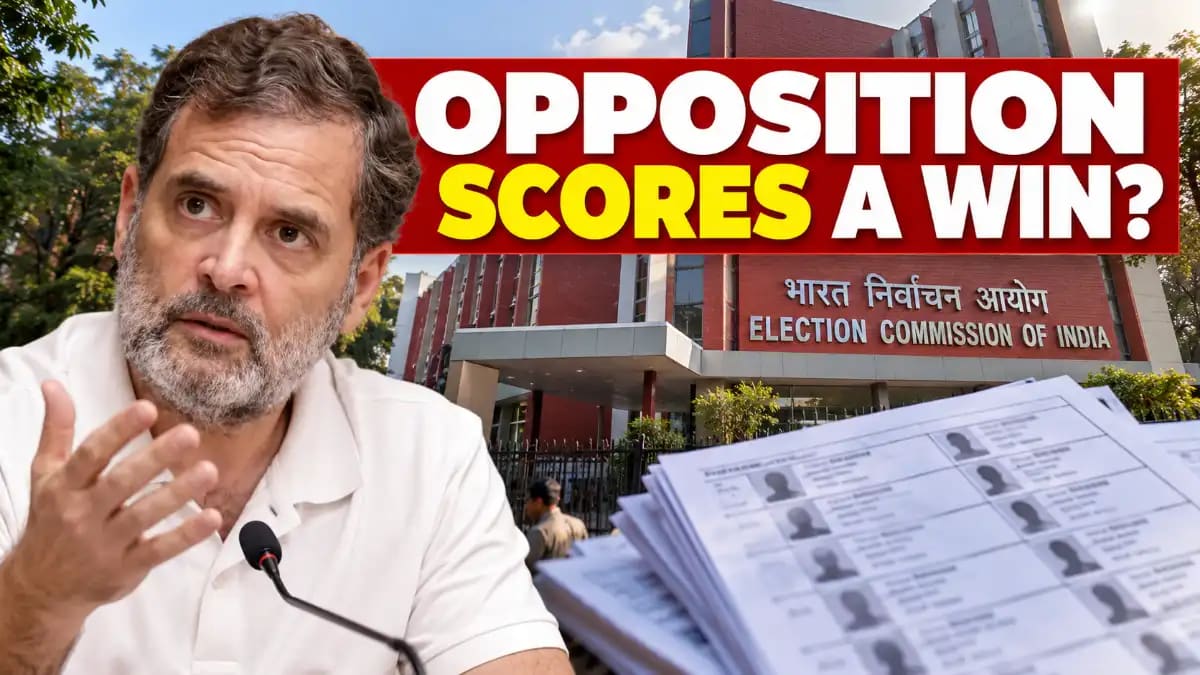

NEW DELHI, October 17, 2026: Opposition parties have gained a potentially important tool for examining electoral rolls after the Election Commission of India (ECI) directed officials to provide recognised political parties with free copies of draft and final voter lists in readable PDF format, alongside printed copies.
The directive, issued on October 15 as part of the Special Summary Revision (SSR) of electoral rolls in 17 states and Union Territories, has been welcomed by Congress as a major political win. The party has linked the development to Rahul Gandhi's long-standing demand for machine-readable voter lists that can be examined more efficiently for possible discrepancies.
Why the decision matters to the Opposition
Voter lists distributed as scanned image PDFs can be difficult to search and analyse systematically. Readable digital files can make it easier to locate names, compare entries and flag possible duplicate, missing or inconsistent records.
Congress has argued that machine-readable electoral rolls would allow political parties to use computer-based analysis instead of relying on time-consuming manual checks. The latest directive could make that scrutiny easier, provided the files supplied are genuinely searchable and suitable for systematic analysis.
For Opposition parties preparing for upcoming elections, the practical benefit could be significant: easier access to voter-list information can help them identify possible errors and raise specific objections through the prescribed electoral process.
What exactly has the Election Commission directed?
According to The Indian Express, the ECI's instructions state that Electoral Registration Officers must provide every recognised political party with two free copies of each polling station's electoral roll after publication: one hard copy and one soft copy in readable PDF format.
The directive applies to draft and final rolls under the SSR process in 17 states and Union Territories. The draft rolls are scheduled for publication on November 12, 2026, with claims and objections invited until December 11. The final rolls are scheduled for publication on January 4, 2027.
The SSR is a periodic exercise intended to update electoral rolls by adding newly eligible voters, correcting entries and removing ineligible records under the applicable procedure. It is distinct from the Special Intensive Revision (SIR), which has been at the centre of a separate political and legal dispute.
A political win, but not proof of voter-list manipulation
Congress has portrayed the directive as a concession to its demand for greater transparency. The move could strengthen the ability of political parties to scrutinise voter data and submit evidence-based objections. However, the announcement alone does not establish that the Election Commission has accepted allegations of electoral manipulation.
There is also an important implementation question. The Indian Express reported that it remains unclear whether the reference to a readable PDF represents a complete change from the earlier format. The actual usability of the files supplied to political parties will determine how much additional scrutiny the directive enables.
Computer-based checks can flag unusual patterns or possible errors, but a flagged entry is not automatically proof of wrongdoing. Electoral records must be verified, and corrections or deletions must follow the official process. The directive should therefore be seen as a potentially useful transparency measure rather than proof that any particular voter list was manipulated.
What happens next?
The key test will come when political parties receive the draft electoral rolls and begin examining them. If the files are genuinely searchable and consistently supplied across the covered states and Union Territories, parties may be better equipped to identify discrepancies and submit timely claims or objections.
For the Opposition, the directive is a political and procedural gain after repeated demands for easier access to electoral data. For voters, its value will depend on whether the process helps identify and correct genuine errors without compromising personal data or removing eligible voters unfairly.
The next stage is implementation. The quality of the digital files, the handling of objections and the transparency of corrections will determine whether this development translates into more effective electoral scrutiny.
Sources:The Indian Express: Why Congress is highlighting machine-readable voter lists; The Indian Express: ECI's Special Summary Revision schedule.
Frequently Asked Questions
Ketan
Editor-in-ChiefPassionate journalist and digital news editor committed to delivering accurate, timely, and fact-checked news.















Comments (0)
Leave a Comment
No comments yet. Be the first to comment!