
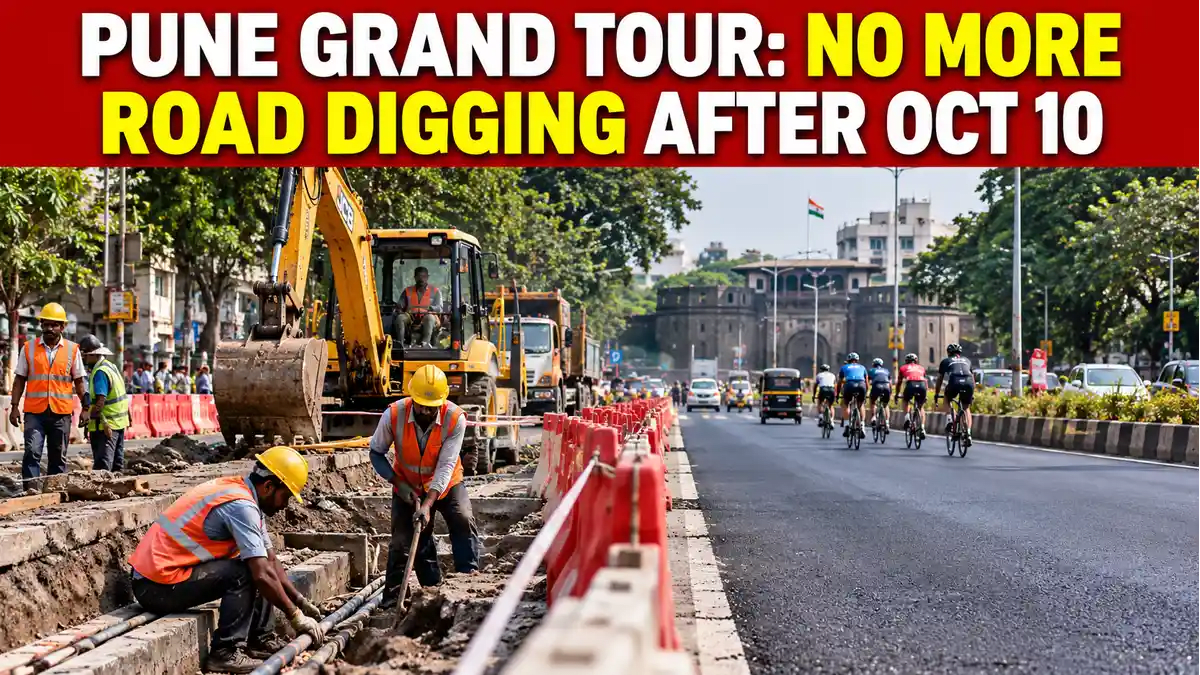

PUNE: The Pune district administration has set October 10, 2026 as the deadline for completing pending underground utility work on roads planned for the 2027 Pune Grand Tour. District Collector Jitendra Dudi has warned that agencies continuing to dig roads after the deadline could face FIRs, as authorities seek to prevent newly improved roads from being repeatedly excavated.
The directive involves the Pune Municipal Corporation (PMC), Pimpri Chinchwad Municipal Corporation (PCMC) and utility agencies including Maharashtra Natural Gas Ltd (MNGL) and Maharashtra State Electricity Distribution Company Ltd (MSEDCL).
Why Has the October 10 Deadline Been Set?
The immediate objective is to ensure that roads selected for the Grand Tour are ready well before the event. Agencies have been instructed to complete underground utility work, road resurfacing, footpath corrections, signage and related infrastructure within the prescribed timeline.
The decision follows concerns arising after the 2026 Pune Grand Tour, when several roads improved for the inaugural event were reportedly dug up again soon after the race. Some stretches were subsequently repaired with patches that authorities considered inadequate.
The latest directive is intended to prevent the same sequence from being repeated in 2027 by ensuring that underground work is completed before final road improvements.
Why Repeated Road Digging Is a Civic Issue
Road excavation is often required for gas pipelines, electricity cables, water infrastructure, telecommunications and other underground services. The problem arises when such work is carried out after a road has already been resurfaced.
Freshly paved roads can then be cut open, leaving joints, patches and uneven surfaces after utility work is completed. This can increase inconvenience for motorists and pedestrians while also affecting the long-term condition of the road.
The October 10 deadline attempts to reverse this sequence by requiring agencies to coordinate underground utility work before final resurfacing takes place.
FIR Warning Signals Tougher Enforcement
The administration has gone beyond simply announcing a deadline. Collector Jitendra Dudi has said that if digging continues after October 10, FIRs could be registered against the agencies concerned by the respective authorities.
Civic bodies have also indicated that agencies failing to comply could face heavy charges. The approach places greater responsibility on utility and civic agencies to coordinate their schedules rather than treating road restoration as a separate process after excavation.
Why the 2027 Grand Tour Is Bigger
The second edition of the Pune Grand Tour is scheduled from January 26 to January 31, 2027, with six stages planned across the district. The proposed routes include Mulshi-Hinjewadi, Baramati-Saswad, Junnar-Rajgurunagar, Alandi-Lonavala/Khandala, Lonavala/Khandala-Hinjewadi and PCMC-Balgandharva Rangmandir.
Earlier planning indicated that the route could expand from around 437 km in 2026 to approximately 1,099 km in 2027, covering 331 villages and 11 talukas. A route of this scale requires extensive coordination and leaves less room for last-minute infrastructure work.
The Issue Also Involves Public Infrastructure Spending
The road-improvement programme associated with the Grand Tour is intended to provide infrastructure benefits beyond the sporting event. The district administration has described the investment as having a longer-term benefit for residents.
With multiple agencies involved in road and utility works, the October 10 deadline is aimed at ensuring that public infrastructure spending is not undermined by excavation soon after resurfacing. The central coordination question is whether underground utility requirements can be completed before roads receive their final improvements.
Grand Tour Preparation Goes Beyond Cycling
The administration has positioned the 2027 Pune Grand Tour as an event linked to tourism, sports infrastructure and regional economic activity. The proposed route passes through areas associated with Pune's historical, religious and natural heritage, including the Sinhagad region, Junnar-Rajgurunagar belt and Lonavala-Khandala ghats.
Preparations also involve coordination among the police, public works department, municipal corporations, PMRDA, health authorities and other agencies. Officials have previously directed departments to focus on road cleanliness, signage, removal of dangerous cables and other safety-related requirements along the race route.
What Happens After October 10?
The effectiveness of the deadline will depend on enforcement and the quality of work completed afterward. Stopping excavation is only one part of the process. Roads, footpaths and other infrastructure damaged during utility work must also be restored according to appropriate standards.
Authorities will need to ensure that underground utility work is completed before final resurfacing, road-cut permissions are monitored, footpaths are repaired and utility agencies coordinate excavation schedules. Emergency utility work may also require a clearly defined approval mechanism.
What Residents Should Watch For
For residents, the longer-term outcome will be whether roads improved ahead of the Grand Tour remain usable after the event. If agencies complete their underground work before final resurfacing, the city could reduce the repeated excavation of newly paved roads.
If coordination fails, the October 10 deadline and FIR warning could become another administrative measure without addressing the underlying infrastructure problem. The coming weeks will therefore test whether Pune's multiple infrastructure agencies can operate according to a coordinated construction schedule.
The Bigger Takeaway
The Pune Grand Tour may be a sporting event, but the roads being prepared for it are ultimately public infrastructure. The significance of the October 10 deadline therefore extends beyond the cycling race.
The key test will be whether underground utility work is completed first, final road improvements are carried out afterward and repeated digging is prevented. For Pune residents, the lasting measure of the 2027 preparation will be whether improved roads remain durable after the cyclists have left.
Frequently Asked Questions
Ketan
Editor-in-ChiefPassionate journalist and digital news editor committed to delivering accurate, timely, and fact-checked news.













Comments (0)
Leave a Comment
No comments yet. Be the first to comment!