
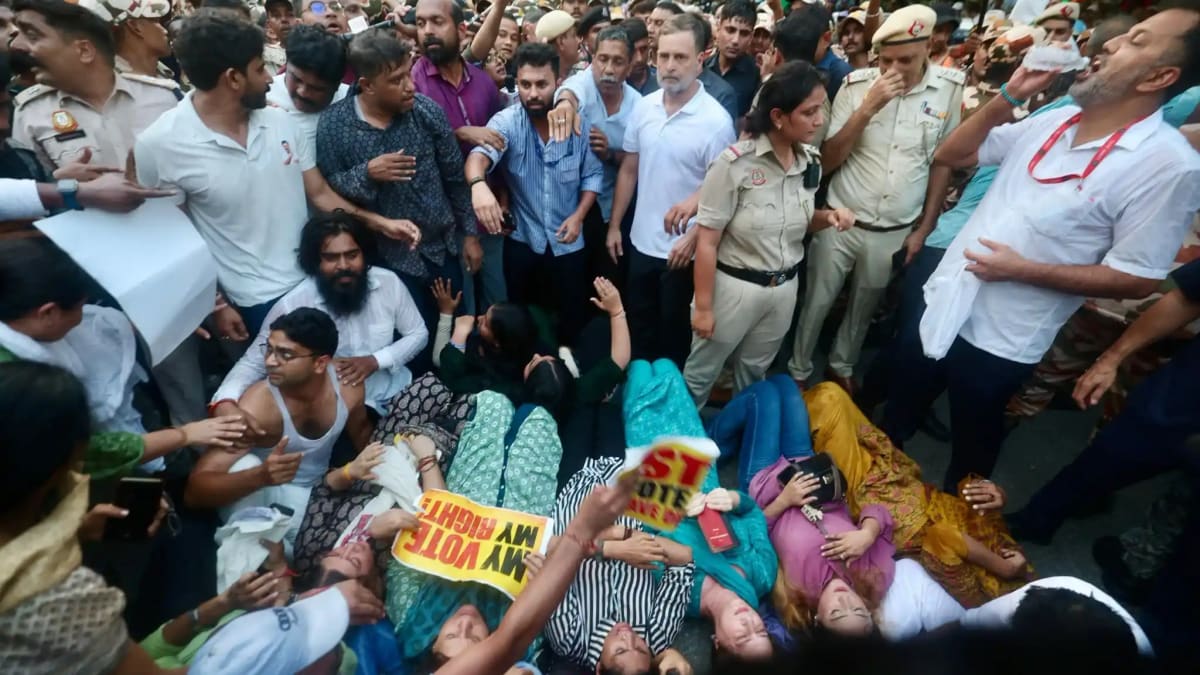

New Delhi: The confrontation between the Opposition and the Election Commission has moved into a new phase, with Rahul Gandhi, Priyanka Gandhi Vadra and several opposition MPs detained in Delhi on October 7 while attempting to march towards Jantar Mantar.
The immediate demand remains unchanged: opposition parties want Chief Election Commissioner Gyanesh Kumar to resign over the Election Commission's Special Intensive Revision (SIR) of electoral rolls. But after two consecutive days of street mobilisation, the dispute is becoming about more than the voter-list revision itself.
It now involves a wider political argument over electoral transparency, institutional accountability and how elected opposition leaders should engage with the country's poll watchdog.
A Second Day of Detentions Changes the Political Picture
Opposition MPs gathered in central Delhi on Wednesday before attempting to move towards Jantar Mantar. Police stopped the protesters and detained several leaders, including Rahul Gandhi and Priyanka Gandhi Vadra.
The action came a day after opposition leaders were detained following a prolonged sit-in near Akashvani Bhavan. The repeated confrontations have ensured that the SIR dispute remains a prominent political issue rather than being confined to parliamentary or institutional proceedings.
For the Opposition, the detentions have become part of the larger argument that concerns over electoral processes are not receiving adequate institutional attention. For authorities, the issue is increasingly connected to maintaining public order during demonstrations.
Why the SIR Dispute Has Become the Centre of the Row
The Special Intensive Revision of electoral rolls is at the heart of the confrontation. Opposition parties have raised concerns about voter-list changes and alleged irregularities in the revision process.
Rahul Gandhi has repeatedly used the phrase “vote chori” while attacking the process. The INDIA bloc has linked its demand for Gyanesh Kumar's resignation to what it describes as a lack of transparency in the handling of electoral rolls.
However, these remain contested political allegations. The Election Commission and the BJP have rejected the Opposition's claims. The poll panel maintains that the revision process is intended to address issues in electoral rolls and has taken corrective measures in response to concerns raised during the exercise.
The Dispute Is Also About Access to the Election Commission
An important but less discussed part of the confrontation concerns how opposition leaders should formally engage with the Election Commission.
According to the Election Commission, opposition MPs had sought a meeting at the Parliament House Annexe. The poll panel said the proposed arrangement did not follow its usual meeting protocol and that its officials had offered to receive a memorandum through a senior official.
The MPs did not accept that arrangement, according to the Election Commission's account.
This has created a second layer to the political dispute. The disagreement is no longer limited to what happened during SIR; it also involves how elected representatives and the country's election authority communicate when there is a serious disagreement over the electoral process.
Why Rahul Gandhi's Detention Matters Politically
Rahul Gandhi's repeated participation gives the protest a much higher political profile than a conventional demonstration by opposition MPs.
As Leader of the Opposition in the Lok Sabha, Gandhi is using the protest to frame the SIR controversy as an issue of democratic accountability rather than a routine administrative disagreement over electoral rolls.
Priyanka Gandhi Vadra and other opposition MPs joining the mobilisation further broadens the political character of the campaign.
At the same time, the Opposition faces a difficult task: sustaining public pressure while ensuring that its allegations remain tied to specific evidence and procedural concerns. The credibility of the campaign will depend not only on the size of demonstrations but also on whether its claims can withstand institutional scrutiny.
CEC's Chhattisgarh Visit Also Postponed
Amid the Delhi confrontation, another development added to the political attention surrounding Gyanesh Kumar. His scheduled two-day visit to Chhattisgarh on October 7 and 8 was postponed.
The state's Chief Electoral Officer's office cited unspecified unavoidable reasons and said revised dates would be communicated later.
The postponement is a separate administrative development and does not establish any connection with the Delhi protests. However, its timing has added to the attention surrounding the Chief Election Commissioner.
What the Opposition Wants—and What the EC Says
| Issue | Opposition Position | Election Commission Position |
|---|---|---|
| SIR electoral-roll revision | Raises allegations of irregularities and demands greater transparency | Says the revision is intended to address voter-list issues |
| CEC Gyanesh Kumar | Demands his resignation | Rejects the allegations against the electoral process |
| Meeting with opposition MPs | Sought direct engagement with the poll panel | Said a memorandum could be received through a senior official |
The competing versions show why the confrontation is difficult to resolve. The Opposition is seeking political accountability, while the Election Commission is defending its procedures and institutional framework.
The Bigger Issue: Trust in the Electoral System
The immediate political fight may be about SIR, but the deeper issue is public confidence in the electoral system.
Electoral-roll revisions are administrative exercises, but they have direct consequences for who appears on voter lists and how citizens participate in elections. That makes transparency and public confidence particularly important whenever large-scale revisions take place.
For the Opposition, challenging the process is therefore an opportunity to raise broader questions about electoral safeguards. For the Election Commission, accepting allegations without sufficient evidence could undermine confidence in an institution responsible for administering elections.
This creates a difficult institutional balance: allegations need to be examined, but the process for resolving them also needs to remain evidence-based and procedurally credible.
Why the Protest Could Become a Longer Political Campaign
The events of October 7 suggest that the dispute is unlikely to disappear immediately. The Opposition has already demonstrated a willingness to continue street mobilisation after the previous day's confrontation.
If the political demand for Gyanesh Kumar's resignation continues, the SIR controversy could become a sustained opposition campaign rather than a short-lived protest.
The next stage will depend on whether the two sides move towards substantive engagement, whether more evidence is presented regarding the voter-list allegations and whether the Election Commission offers further clarification on the concerns being raised.
The Key Test Is What Comes After the Protests
Street protests can create political visibility, but they cannot by themselves settle questions about electoral-roll accuracy.
The more consequential test will be whether concerns about SIR are addressed through transparent procedures, verifiable data and credible institutional mechanisms.
For the Opposition, the challenge is to convert political mobilisation into specific demands that can be independently examined. For the Election Commission, the challenge is to demonstrate that its processes are transparent enough to withstand intense political scrutiny.
What Happens Next?
The immediate political standoff remains unresolved. Opposition parties continue to demand Gyanesh Kumar's resignation, while the Election Commission and BJP reject the allegations surrounding the electoral-roll revision.
With the confrontation now entering its second consecutive day, the dispute has moved beyond a single protest. It has become a wider political test of how electoral institutions respond when major opposition parties challenge their procedures and credibility.
Are the Allegations Against the Election Commission Proven?
No. The allegations of electoral manipulation and irregularities described by opposition parties remain contested political claims. The Election Commission and BJP have rejected them, and the dispute remains politically unresolved.
Why Is Rahul Gandhi Protesting Against CEC Gyanesh Kumar?
Rahul Gandhi and opposition parties are demanding Gyanesh Kumar's resignation over concerns they have raised regarding the Special Intensive Revision of electoral rolls and the handling of voter-list changes.
Why Were Rahul Gandhi and Priyanka Gandhi Detained?
They were detained by Delhi Police on October 7 after opposition leaders attempted to march towards Jantar Mantar during the protest against the Election Commission and CEC Gyanesh Kumar.
What Is the Special Intensive Revision?
The Special Intensive Revision, or SIR, is an electoral-roll revision exercise intended to address issues in voter lists. The current political dispute centres on opposition allegations about how the process is being conducted and the Election Commission's response to those concerns.
The Rahul Gandhi-led protest has pushed the SIR controversy into a broader confrontation over electoral trust and institutional accountability. The repeated detentions have increased political pressure, but they have not resolved the underlying dispute.
The decisive question now is not simply whether the Opposition can keep protesters on the streets. It is whether the allegations and concerns surrounding SIR can be addressed through evidence, transparency and credible institutional mechanisms.
Ketan
Editor-in-ChiefPassionate journalist and digital news editor committed to delivering accurate, timely, and fact-checked news.













Comments (0)
Leave a Comment
No comments yet. Be the first to comment!