
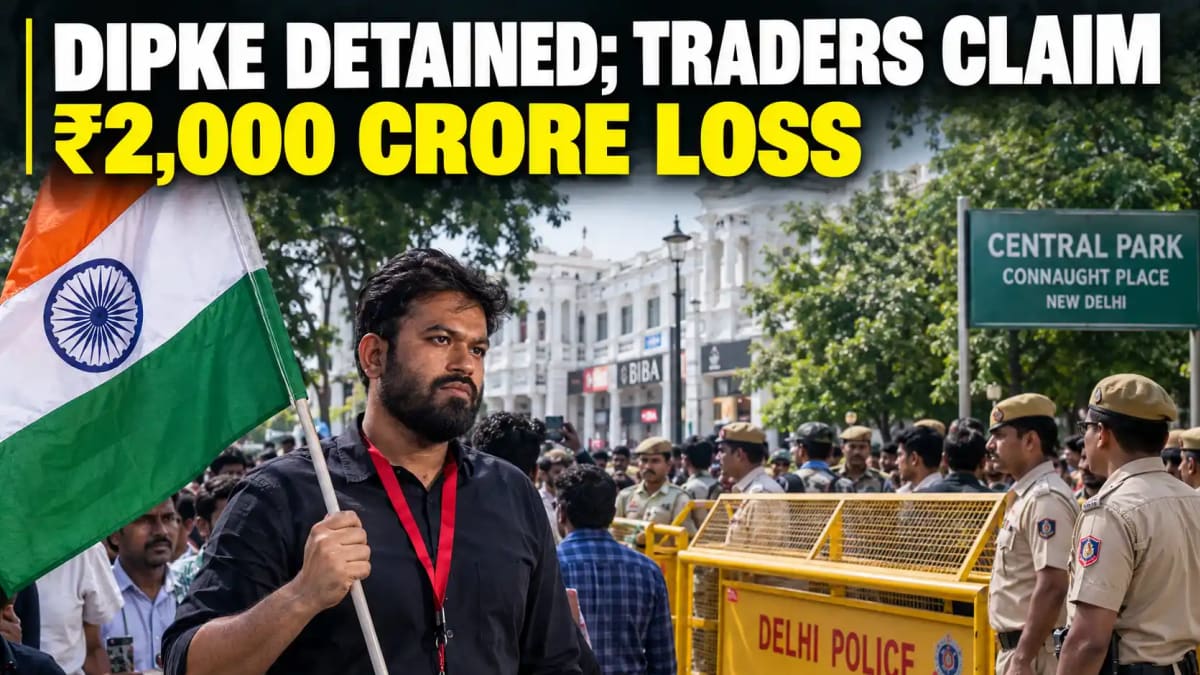

NEW DELHI, October 16, 2026: Delhi Police detained Cockroach Janata Party (CJP) founder Abhijeet Dipke on Friday ahead of the organisation's proposed 'Lehra Do Tiranga' march at Central Park in Connaught Place. The action followed a police notice prohibiting the gathering, with authorities citing public-order restrictions, traffic concerns and the absence of permission for the proposed event.
Police also began dispersing people who had assembled in the commercial district. Dipke questioned the restrictions, arguing that the proposed gathering was intended to wave the national flag and exercise the right to peaceful expression.
The proposed march came amid continuing CJP demonstrations demanding the resignation of Chief Election Commissioner Gyanesh Kumar over alleged irregularities in the Special Intensive Revision (SIR) of electoral rolls. The Election Commission has rejected allegations of political bias.
Why did Delhi Police restrict the march?
According to the notice served on Dipke, prohibitory orders under Section 163 of the Bharatiya Nagarik Suraksha Sanhita were in force in the Connaught Place area. Police said an unauthorised gathering could obstruct traffic, affect public movement and disrupt commercial activity.
The notice also referred to previous CJP demonstrations and alleged violations of conditions imposed for earlier gatherings. Police said designated protest venues were available, subject to the necessary permissions.
Dipke disputed the restrictions, maintaining that peaceful demonstrations should not be treated as unlawful merely because they challenge those in power. Whether particular restrictions were lawful and proportionate remains a matter for judicial scrutiny.
Restaurant owner seeks relief over alleged business losses
Separately, Aayush Chopra, whose family has operated Minar Restaurant in Connaught Place since 2017, approached the Delhi High Court seeking compensation for alleged business losses linked to protest-related disruption. His petition also sought directions to prevent the proposed gathering at Central Park and to stop other unauthorised demonstrations in the commercial area.
The petition cited estimates of ₹150 crore to ₹200 crore in affected business in Connaught Place on October 10, attributed to the New Delhi Traders Association. It also cited a broader estimate of ₹2,000 crore in affected business across Delhi, attributed to the Chamber of Trade and Industry.
These amounts are estimates cited in legal submissions. They should not be treated as independently verified net losses, a judicial finding of damages or compensation already awarded by a court.
Traders have said that repeated protest announcements and security restrictions have discouraged customers from visiting the area, affecting restaurants, shops and other businesses. Hospitality-sector representatives have urged protest organisers to consider designated venues away from busy commercial districts.
Supreme Court to examine restrictions and possible compensation
The Supreme Court indicated on Friday that it would examine whether restrictions imposed in Connaught Place were disproportionate. During a hearing concerning the impact on traders, the bench said it had the power to award compensation if unlawful restrictions were found to have caused losses.
The court did not award compensation at this stage. The matter was scheduled for further hearing on October 26, after the Dussehra break.
The proceedings could bring closer judicial scrutiny of how authorities balance public-order measures with the rights of traders, commuters and protesters. Any compensation would depend on the court's assessment of the legal issues and evidence of the alleged losses.
A continuing debate over the right to protest
The confrontation reflects a wider debate over peaceful assembly in the national capital. CJP argues that citizens must be able to question elected governments and demand accountability. Police authorities maintain that demonstrations must comply with lawful restrictions and cannot compromise public safety or movement.
The economic impact claimed by traders adds another dimension to the dispute. Key questions include whether the restrictions were proportionate, how the alleged business losses can be substantiated and whether any party can be held legally responsible for proven harm.
The next significant development is expected at the scheduled Supreme Court hearing on October 26. Until the claims are examined and supported by evidence, the cited business-impact figures remain estimates presented in legal submissions, while the legal questions surrounding the protest restrictions remain unresolved.
Frequently Asked Questions
Ketan
Editor-in-ChiefPassionate journalist and digital news editor committed to delivering accurate, timely, and fact-checked news.















Comments (0)
Leave a Comment
No comments yet. Be the first to comment!