
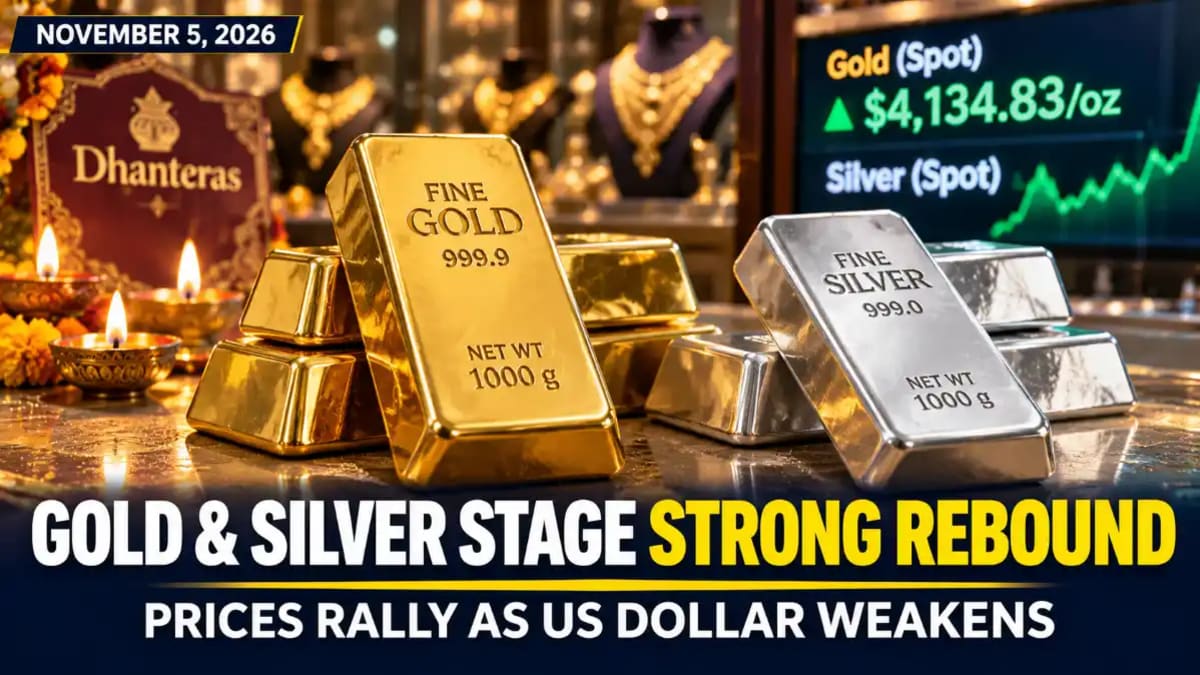

Indian gold and silver buyers have received an unwelcome festive-season surprise. After suffering a sharp correction in October, precious-metal prices staged a strong recovery on November 4 and continued gaining in international markets on November 5, 2026. The rally followed the Democratic Party's victory in the US midterm elections, which weakened the US dollar and pushed Treasury yields lower.
The timing is particularly important for Indian households preparing for Dhanteras and Diwali purchases. Families planning to buy jewellery, gold coins or silver articles may now face higher costs if the recovery continues. However, one important distinction remains: a sudden market rally does not automatically mean prices will keep rising.
Gold and silver prices rise: What happened in the market?
Gold and silver recorded substantial gains in domestic and international markets on Wednesday, November 4. The December gold futures contract on the Multi Commodity Exchange (MCX) traded around ₹1,43,293 per 10 grams in the historical exchange data, while the exchange's chart showed a previous-close reference of ₹1,43,234. These are futures-market figures, not guaranteed retail jewellery rates.
Silver also recorded a strong recovery. Livemint's November 4 market data showed the MCX silver contract around ₹1,87,350 per kilogram, up approximately 4.26% at the reported time. Futures prices can change during the trading session, and different reporting timestamps may produce different figures.
Internationally, Reuters reported on November 5 that spot gold climbed nearly 2% to $4,134.83 per troy ounce, reaching a two-week high. US December gold futures also advanced. Spot silver gained around 1.7% during the reported session.
These figures refer to different instruments and trading sessions. MCX futures, international spot prices and international futures should not be treated as identical price quotations.
Why did gold and silver prices rise after the US midterm elections?
The immediate market trigger was the Democratic Party's victory in the November 3 US midterm elections. Democrats secured control of both the Senate and the House of Representatives, dealing a significant political setback to President Donald Trump and the Republican Party.
Reuters reported that the election outcome was followed by a weaker US dollar and a decline in Treasury yields. These movements helped support demand for precious metals.
There are several reasons why these developments matter to bullion investors:
- Weaker US dollar: Gold and silver are internationally priced in US dollars. When the dollar weakens, these metals can become relatively cheaper for buyers using other currencies, potentially supporting demand.
- Lower Treasury yields: Gold does not pay interest. When government bond yields decline, the opportunity cost of holding non-interest-bearing assets such as gold becomes lower.
- Political uncertainty: Investors reassess economic, trade and fiscal policy expectations after significant election outcomes. Such uncertainty can influence demand for assets considered stores of value.
- Interest-rate expectations: Markets are also assessing the Federal Reserve's future decisions. Expectations of lower borrowing costs can support precious metals, although inflation concerns and a more hawkish policy outlook can limit gains.
However, the election result should not be viewed as the only reason behind the rally. Currency movements, bond yields, economic data, geopolitical developments and investor positioning also influence precious-metal prices.
Reuters' November 4 market report and its November 5 update describe the relationship between the election outcome, the dollar, Treasury yields and bullion prices.
Why Indian buyers could feel the impact ahead of Dhanteras
Gold purchases during Dhanteras are an important tradition for many Indian households. Consumers commonly purchase jewellery, coins and small gold articles during the festival, while silver utensils and other silver products also see seasonal demand.
When international gold and silver prices rise, domestic bullion rates can come under upward pressure. The final Indian price, however, also depends on the rupee-dollar exchange rate, import-related costs, domestic demand and local market conditions.
For jewellery buyers, the price displayed in a market report is not necessarily the amount they will pay at the showroom. Retail prices differ by city, purity and jeweller. GST, making charges and other applicable costs can increase the final bill.
In practical terms, a rise in the international gold price can affect household budgets even when the movement in the domestic retail rate is not exactly the same as the percentage change in global markets.
Will gold and silver prices continue to rise?
The next direction of the bullion market will depend on more than the US election outcome. Investors are watching the US dollar, Treasury yields, Federal Reserve policy expectations and upcoming American economic indicators.
Reuters reported on November 5 that gold had climbed to a two-week high as the dollar and Treasury yields eased. Investors were also awaiting US employment data for fresh signals about the economy and the interest-rate outlook.
If the dollar remains weak and yields decline further, precious metals could receive additional support. On the other hand, stronger economic data, persistent inflation or expectations of tighter monetary policy could put pressure on gold and silver.
Silver may also experience sharper price swings than gold because it has both investment demand and significant industrial uses. This makes its market performance particularly sensitive to changes in economic expectations.
Therefore, the recent rally should not be interpreted as a guarantee of further price increases. Buyers and investors should assess their own requirements rather than making decisions based only on short-term market movements.
What should gold and silver buyers check before purchasing?
Consumers planning festive-season purchases should compare the following factors before visiting a jewellery store:
- Check the latest local 22-carat and 24-carat gold rates.
- Compare silver prices per kilogram or per gram, depending on the product.
- Check the purity and hallmarking details of gold jewellery.
- Ask for a clear breakdown of making charges and applicable GST.
- Compare final quotations from more than one established jeweller.
- Track international bullion prices and the rupee-dollar exchange rate.
Buyers should also distinguish between jewellery purchases and investment products. Jewellery involves additional making charges and resale considerations, while coins, bars and exchange-traded products have different costs and risks.
What the latest rally means for Indian consumers
The recovery in gold and silver prices highlights how developments in the United States can influence India's bullion market. A change in the political balance in Washington was followed by movements in the dollar and bond yields, which helped precious metals recover after their recent decline.
For Indian households, the timing is inconvenient: festive purchases are approaching just as bullion prices are recovering. But the market remains sensitive to economic data and central-bank expectations, meaning further volatility is possible.
In other words, the festive shopping budget may need another look. Whether the next move is upward or downward, checking the actual local retail rate and the complete jewellery bill is more useful than relying on a dramatic international market headline.
Frequently Asked Questions
Ketan
Editor-in-ChiefPassionate journalist and digital news editor committed to delivering accurate, timely, and fact-checked news.













Comments (0)
Leave a Comment
No comments yet. Be the first to comment!