
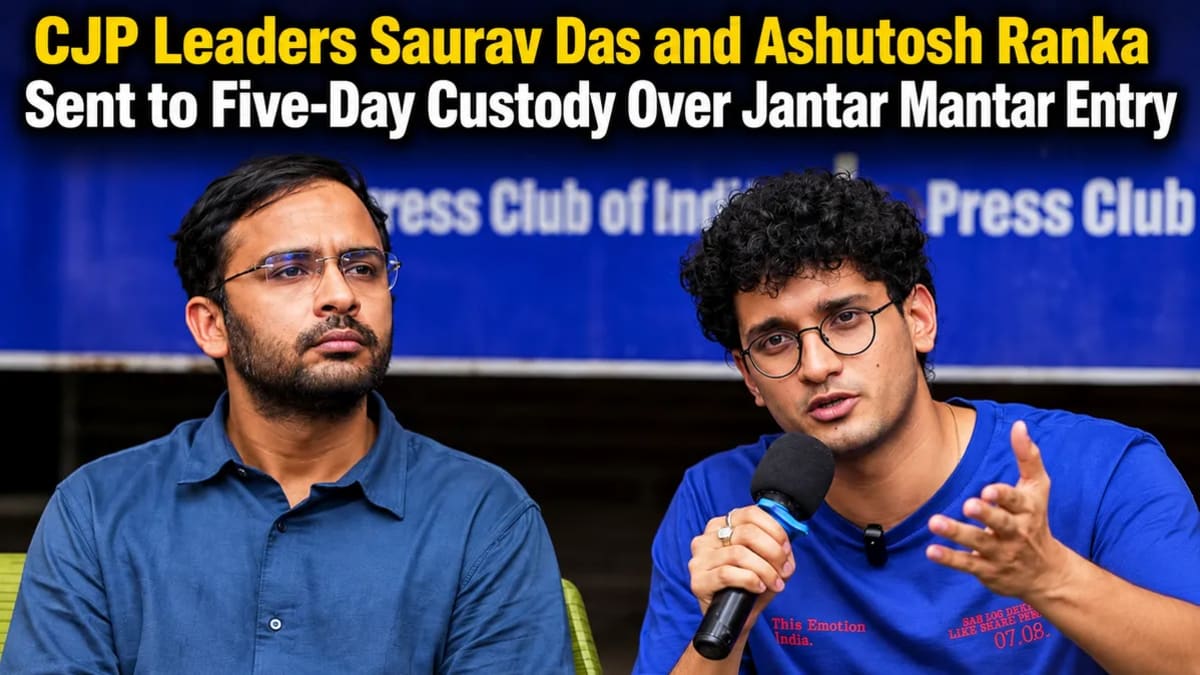

New Delhi, October 14, 2026: Cockroach Janta Party (CJP) leaders Saurav Das and Ashutosh Ranka have been sent to five days of judicial custody at Tihar Jail after allegedly entering the now-denotified Jantar Mantar protest area without authorisation. A Special Executive Magistrate passed the order on Wednesday, while CJP member Ajinkya Shinde was released after signing a peace bond, according to media reports.
The incident follows Delhi Police's decision to remove Jantar Mantar from the list of designated protest venues and name Ramlila Maidan, Burari Ground and CBD Ground as alternatives. CJP has opposed the change, arguing that shifting demonstrations away from the political centre of the capital could reduce their visibility. Police, meanwhile, have cited alleged unauthorised entry, obstruction of officials and violations of earlier peace-bond conditions in explaining the action.
The case brings two important democratic principles into focus: the right to peaceful assembly and the state's authority to regulate public spaces for safety and order. Neither principle automatically overrides the other. The legality and proportionality of the specific actions must be assessed on the evidence and applicable law.
What happened at Jantar Mantar?
According to reports, a group of around 14 CJP members entered the barricaded area on the morning of October 13. Police alleged that members reached the site through adjacent premises and climbed a locked gate before entering the area. The group reportedly displayed the Indian national flag and raised slogans demanding the resignation of Chief Election Commissioner Gyanesh Kumar over alleged irregularities in the Special Intensive Revision (SIR) of electoral rolls.
Police detained the group and registered two FIRs against 14 people in connection with the incident. Reported allegations include trespass, disobedience of orders, obstruction of public servants and breach of earlier peace-bond conditions. The precise charges and their legal consequences must be assessed through the relevant records and proceedings; an FIR records allegations and does not establish guilt.
The party has framed the action as an attempt to reclaim a traditional protest location. Police have argued that the entry was unauthorised and that the circumstances warranted intervention. These accounts reflect the competing positions in the dispute and should not be treated as interchangeable findings of fact.
Why was Jantar Mantar denotified?
Delhi Police Commissioner Anurag Kumar issued an order on October 11 designating Ramlila Maidan, Burari Ground and CBD Ground in East Delhi as alternative venues for demonstrations. Jantar Mantar was removed from the designated list following a review of protest locations and recommendations linked to a committee constituted by the Union Ministry of Home Affairs.
Authorities have a legitimate responsibility to manage public order, traffic, crowd safety and access to sensitive areas. Designating specific sites can help organise demonstrations and reduce disruption. However, the effectiveness of such a policy also depends on whether the alternative locations are accessible, whether permission procedures are transparent and whether citizens can meaningfully communicate their demands to the institutions concerned.
CJP argues that moving protests away from central Delhi weakens their visibility and political impact. That concern does not by itself prove the order unlawful, but it raises a question that deserves a substantive answer: do the new venues provide a workable means of exercising the right to peaceful assembly, or do distance and administrative hurdles make that right harder to exercise in practice?
Why were Das and Ranka sent to custody?
Police have cited alleged repeated violations, the circumstances of the entry and concerns about further disturbances. Reports state that Das and Ranka had signed peace bonds after an earlier detention linked to protests in Delhi. Authorities argued that the latest incident involved violations of those conditions.
The Special Executive Magistrate subsequently ordered five days of judicial custody for the two leaders. Shinde was released after signing a fresh peace bond. These outcomes differ, and the reasons recorded in the relevant order are important to understanding why different measures were applied to the individuals involved.
Judicial custody is not a conviction. The remand order does not, by itself, establish that the allegations are true or settle any challenge to the denotification of Jantar Mantar. The legal basis for detention, the applicable procedures and the proportionality of the action remain matters for proper scrutiny.
CJP alleges procedural irregularities
CJP's legal representatives have alleged irregularities in the handling of the detained activists, including transfer in a private vehicle during the early hours and delayed access to lawyers. These are allegations by the party's legal side and should be verified against official records, custody documentation and any subsequent judicial observations.
Access to legal counsel and compliance with detention procedures are not secondary issues in a politically sensitive case. Authorities should be able to explain the legal basis and timeline of custody, while any challenge to their conduct should be assessed through evidence rather than political claims alone.
The constitutional question: Protest rights and lawful restrictions
Article 19(1)(b) of the Constitution of India protects citizens' right to assemble peaceably and without arms. Article 19(3) permits reasonable restrictions on that right in the interests of public order and on other constitutionally specified grounds. The right to protest is therefore not absolute, but neither does the power to regulate public spaces mean that every restriction is automatically justified.
Two questions must be kept separate. First, were the activists legally entitled to enter the barricaded site after it had been removed from the list of designated venues? Second, are the rules governing access to protest locations reasonable, transparent and compatible with meaningful peaceful assembly? A finding about the alleged conduct of individual protesters would not automatically resolve the broader policy question, and criticism of the policy would not automatically excuse an unlawful entry.
A fair assessment requires attention to the applicable orders, the exact allegations, the grounds recorded for custody, access to legal representation and the availability of practical alternatives for lawful demonstrations.
Questions that authorities and the courts must address
- What specific legal provisions and orders governed entry into the Jantar Mantar area on October 13?
- What reasons did the Special Executive Magistrate record for ordering five days of judicial custody for Das and Ranka?
- Were the earlier peace-bond conditions clear, lawful and applicable to the conduct alleged in this incident?
- What evidence supports or contradicts the allegations concerning access to legal counsel and the handling of the detained activists?
- Do the new protest venues offer accessible facilities, transparent permissions and a meaningful opportunity to reach the intended audience?
The Jantar Mantar case is about more than the conduct of one group or a single police operation. It tests how democratic institutions manage dissent when a traditional protest location is withdrawn and activists challenge that decision. Police must enforce lawful orders fairly; protesters must comply with valid restrictions; and courts must examine contested actions independently. The credibility of the outcome will depend on evidence, due process and whether the rules leave meaningful space for peaceful public disagreement.
Frequently Asked Questions
Ketan
Editor-in-ChiefPassionate journalist and digital news editor committed to delivering accurate, timely, and fact-checked news.













Comments (0)
Leave a Comment
No comments yet. Be the first to comment!