
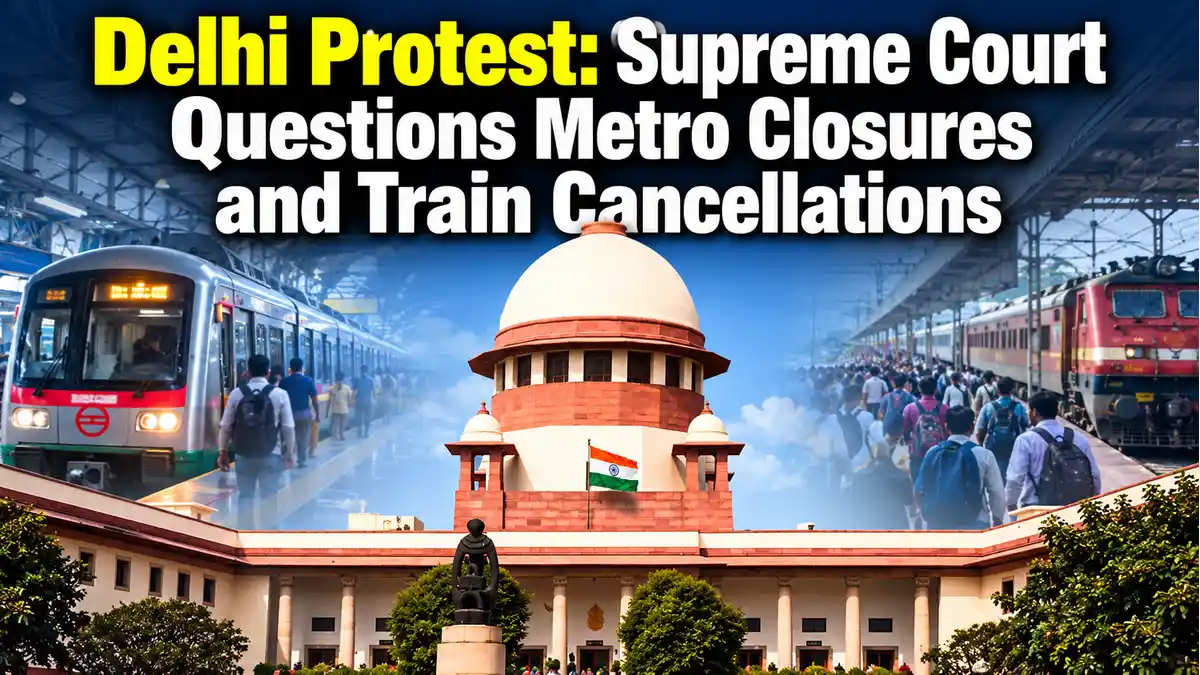

The Supreme Court of India has intervened in the escalating transit disruption across the capital, questioning the sweeping restrictions imposed on public transport ahead of the October 10, 2026 demonstration organized by the Cockroach Janta Party (CJP). Addressing law-enforcement measures that sought to restrict operations across 57 Delhi Metro stations and cancel several inbound mail and express trains, the apex court emphasized that maintaining public order cannot come at the expense of paralyzing everyday urban mobility.
The Principle of Proportionality in Crowd Control
During proceedings on October 9, the bench voiced serious concern over administrative recommendations that proposed shutting down transit corridors serving central and peripheral Delhi. Authorities had cited security risks and potential overcrowding linked to the planned march demanding the resignation of Chief Election Commissioner (CEC) Gyanesh Kumar.
The court observed that security responses must remain proportionate. The bench underlined that while maintaining law and order is a legitimate administrative responsibility, entirely severing access to primary civic transit networks penalizes ordinary commuters, hospital visitors, students, and office workers.
"Security measures must remain proportionate. Public transport networks cannot be completely shut down to manage a demonstration, leaving ordinary residents stranded across the city."
Directives for Regulated Transit and Clear Advisories
To mitigate hardships for the general public, the Supreme Court directed Delhi Police, the Delhi Metro Rail Corporation (DMRC), and Indian Railways to maintain regulated and calibrated transit services rather than sweeping shutdowns. The court mandated that:
- Essential interchange facilities and primary access gates remain accessible wherever ground conditions permit.
- Authorities publish real-time traffic and transit advisories well in advance to prevent confusion at railway stations and bus terminuses.
- Law-enforcement agencies implement targeted crowd-control protocols instead of preemptively paralyzing multi-modal urban transit.
Following the court's directions, a subsequent contempt petition was brought before the bench alleging that on-ground curbs and barricades continued unabated; the matter remains under active judicial consideration.
Balancing Law and Order with Citizen Mobility
The apex court's intervention highlights an enduring constitutional challenge: reconciling the administrative necessity of public safety with the fundamental freedom of citizens to navigate their cities freely. By questioning wholesale metro station closures and train disruptions, the court reaffirmed that administrative convenience cannot override the public's right to functional civic infrastructure.
Frequently Asked Questions
Ketan
Editor-in-ChiefPassionate journalist and digital news editor committed to delivering accurate, timely, and fact-checked news.











Comments (0)
Leave a Comment
No comments yet. Be the first to comment!