
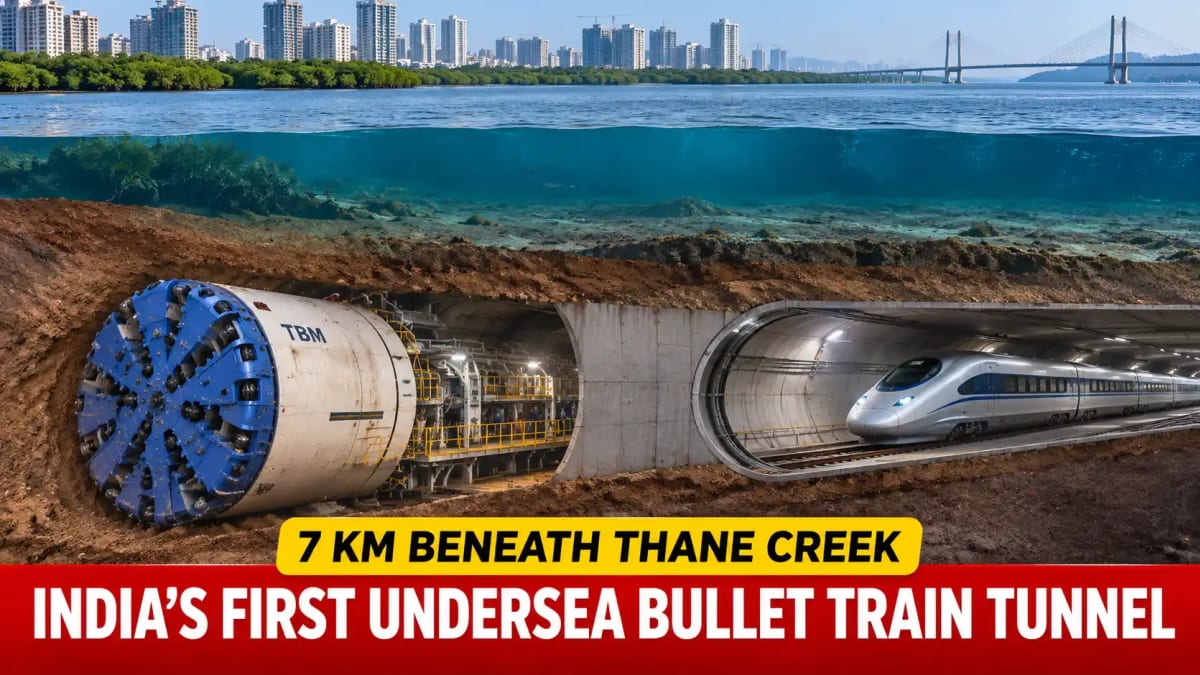

India is set to achieve a major infrastructure milestone with the construction of its first underwater railway tunnel in Navi Mumbai, a critical component of the ambitious Mumbai-Ahmedabad High-Speed Rail (MAHSR) corridor. This 7-kilometer long tunnel, designed to carry the bullet train at depths equivalent to a 35-story building, is currently under construction beneath the Thane Creek, promising to revolutionize connectivity between the two major economic hubs.
Engineering Marvel Beneath Thane Creek
The underwater section, a significant engineering challenge, forms part of the 21-kilometer tunnel package between the Bandra-Kurla Complex (BKC) in Mumbai and Shilphata. Of this, 7 kilometers will be submerged beneath the Thane Creek, with approximately 1.8 kilometers traversing the intertidal mudflats and the remaining 5.2 kilometers under the seabed. Project officials confirm that the tunnel will be constructed at a depth of 25 to 65 meters below the ground level, reaching its deepest point at 65 meters, which is comparable to the height of a 35-story skyscraper.
Construction Techniques and Challenges
- Tunnel Boring Machines (TBMs): Three TBMs will be deployed for the construction of this single-tube tunnel, each with a diameter of 13.1 meters.
- Shafts: Access shafts will be constructed at various points, including one at BKC, one near Ghansoli (Navi Mumbai), and one at Shilphata. The Ghansoli shaft will be particularly crucial for the underwater section.
- Geological Surveys: Extensive geotechnical and seismic surveys have been conducted to understand the complex geology of the seabed, which includes basalt, shale, and breccia formations.
- Environmental Considerations: Special measures are being taken to minimize environmental impact, particularly concerning the sensitive mangrove ecosystems in the Thane Creek area.
The Broader Mumbai-Ahmedabad High-Speed Rail Corridor
The underwater tunnel is a pivotal segment of the 508-kilometer Mumbai-Ahmedabad High-Speed Rail (MAHSR) project, often referred to as the 'Bullet Train' project. This flagship initiative aims to connect India's financial capital, Mumbai, with Ahmedabad in Gujarat, significantly reducing travel time to approximately two hours from the current seven to eight hours by conventional rail.
Project Scope and Funding
- Total Cost: The estimated cost of the entire MAHSR corridor is approximately ₹1.08 lakh crore (approximately $13 billion).
- Funding Source: A substantial portion of the funding, around 81%, is being provided through a soft loan from the Japan International Cooperation Agency (JICA).
- Stations: The corridor will feature 12 stations: Mumbai, Thane, Virar, Boisar, Vapi, Bilimora, Surat, Bharuch, Vadodara, Anand, Ahmedabad, and Sabarmati.
- Operational Speed: The Shinkansen E5 series trains are designed to operate at a maximum speed of 320 kilometers per hour.
Project Progress and Future Outlook
While the Gujarat section of the MAHSR project has seen rapid progress, with significant portions of viaducts and stations nearing completion, the Maharashtra segment, particularly the tunnel work, has faced delays primarily due to land acquisition challenges. However, sources familiar with the development indicate that these hurdles are being systematically addressed.
"The underwater tunnel is not just an engineering feat; it's a testament to India's growing capabilities in high-tech infrastructure. It will set a new benchmark for future projects and significantly boost regional connectivity," a senior NHSRCL official stated, requesting anonymity due to ongoing project sensitivities.
The National High-Speed Rail Corporation Limited (NHSRCL), the implementing agency, is pushing for an expedited completion, with the Gujarat section targeted for operationalization by 2026. The completion of the entire corridor, including the complex underwater tunnel, is expected to follow, transforming intercity travel and fostering economic growth along the route.
Frequently Asked Questions
Ketan
Editor-in-ChiefPassionate journalist and digital news editor committed to delivering accurate, timely, and fact-checked news.











Comments (0)
Leave a Comment
No comments yet. Be the first to comment!