
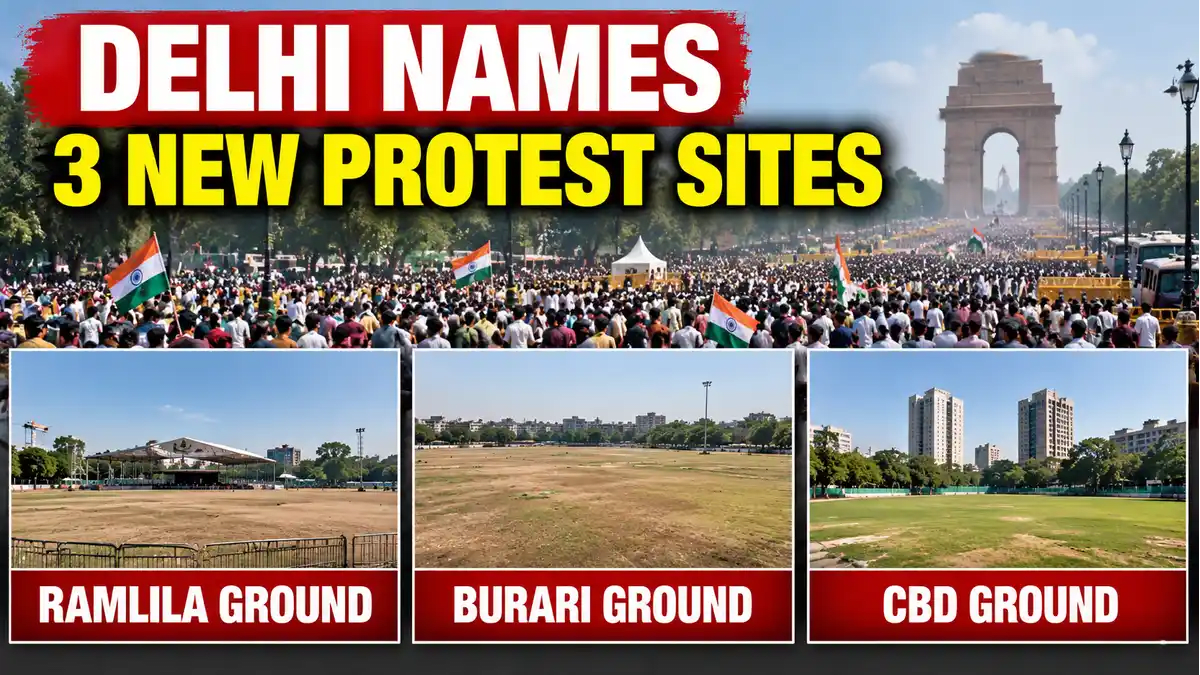

New Delhi, October 12, 2026: Delhi Police has removed Jantar Mantar from the list of designated venues for protests and demonstrations, naming Ramlila Ground, Burari Ground and CBD Ground in East Delhi as alternative locations. The decision was announced through a standing order issued by Delhi Police Commissioner Anurag Kumar on October 11.
According to the order, the change follows recommendations from a committee constituted by the Union Ministry of Home Affairs (MHA) to examine alternative venues where citizens could organise protests and demonstrations. The order partially modifies an earlier standing order issued in April 2022. Delhi Police has said that revised standard operating procedures (SOPs) for demonstrations at the new venues will be issued separately.
The decision comes amid heightened tensions in the capital following demonstrations by the Cockroach Janta Party (CJP) and other groups over alleged irregularities in the Special Intensive Revision (SIR) of electoral rolls. It has also renewed debate over how authorities should balance public order, traffic management and the right to peaceful assembly.
Which venues have replaced Jantar Mantar?
Delhi Police has designated three alternative venues for future demonstrations:
- Ramlila Ground, Central Delhi: One of the city's established locations for large public gatherings and political events.
- Burari Ground, North Delhi: A venue situated farther from the central government district and the Parliament area.
- CBD Ground, East Delhi: A designated location in East Delhi for organising protests and demonstrations.
The venues differ in their distance from central Delhi, where Parliament and several key government offices are located. That distinction may affect how easily protesters can reach a site, how visible a demonstration becomes and whether journalists, supporters and members of the public can access it.
The exact procedures for applying for permission, managing crowd capacity and organising demonstrations at the new venues will depend on the revised SOPs. Until those details are available, organisers may need further clarification from the police about the conditions governing future protests.
Why has Jantar Mantar been denotified?
The police order cites recommendations from the MHA-constituted committee examining alternative protest venues. The decision follows repeated demonstrations in central Delhi, including recent protests demanding the resignation of Chief Election Commissioner Gyanesh Kumar over alleged irregularities in the revision of electoral rolls.
Authorities must manage public safety, traffic, crowd movement and access to sensitive government areas. Designating specific locations for demonstrations can be part of that responsibility. However, the effectiveness of such arrangements also depends on whether the selected venues are accessible and allow protesters to communicate their demands to the public and the institutions they seek to address.
Critics argue that shifting demonstrations away from Jantar Mantar could reduce the visibility and political impact of protests. Burari, in particular, is considerably farther from the central administrative district. The practical consequences will depend on transport access, the permission process, venue capacity and the conditions imposed on demonstrations.
CJP questions the decision
CJP has criticised the removal of Jantar Mantar from the list of designated protest venues. Party representatives have questioned whether protest organisations were consulted before the decision and have described the move as an infringement on the ability to demonstrate in a prominent public location.
The organisation has also sought clarity from Delhi Police about permission for another peaceful demonstration at Jantar Mantar, reportedly asking the authorities to communicate a date and time within 24 hours. Its response reflects the immediate dispute over the venue as well as the wider disagreement over how public demonstrations should be regulated.
These are the objections raised by the protest organisers. The police order, its stated administrative basis and any subsequent judicial findings must be considered separately when assessing the legality and proportionality of the decision.
Delhi High Court challenge expected on October 13
The Delhi High Court is scheduled to hear petitions on October 13 concerning the removal of Jantar Mantar as a designated protest site and allegations that demonstrators were harassed by outsiders during recent protests. The court had declined an urgent hearing on October 12, noting that the Supreme Court was also examining related protest restrictions.
The petitions raise questions about the availability of lawful locations for peaceful demonstrations and the protection of people participating in public gatherings. The court's consideration does not, by itself, mean that the police order has been declared unlawful. The legal arguments and the authorities' response will need to be examined before any conclusion can be drawn.
Does denotification mean protests are banned across Delhi?
Removing Jantar Mantar from the list of designated venues does not automatically establish that all peaceful protests are banned throughout Delhi. Demonstrations remain subject to applicable permission requirements, public-order regulations and lawful restrictions. The practical question is whether the arrangements provide meaningful opportunities for peaceful assembly while addressing legitimate safety concerns.
Article 19(1)(b) of the Constitution protects citizens' right to assemble peaceably and without arms, subject to reasonable restrictions under Article 19(3) in the interests of public order and other constitutionally permitted grounds. The right is not absolute, but restrictions must have a lawful basis and cannot be assessed solely by the administrative convenience they offer.
For the authorities, the challenge is to demonstrate that the alternative venues and permission procedures are workable and proportionate. For protest organisers, compliance with lawful conditions remains important. The courts may be called upon to assess whether the new arrangements strike a constitutionally permissible balance.
Questions that remain unanswered
- What specific reasons led the committee to recommend replacing Jantar Mantar with the three new venues?
- Were protest organisations and other relevant stakeholders consulted before the decision?
- How will the new venues compare with Jantar Mantar in terms of public transport, accessibility, capacity and media visibility?
- What criteria will Delhi Police use to grant or deny permission for demonstrations under the revised SOPs?
- Will the Delhi High Court or Supreme Court issue directions affecting the new arrangements?
Jantar Mantar has long served as a recognisable location for public demonstrations in the national capital. Its removal from the designated protest list marks a significant change in how official protest venues are organised. Whether the alternatives provide an effective and accessible way for citizens to express dissent will depend on the details of the new procedures, their implementation and the outcome of the legal challenges.
Frequently Asked Questions
Ketan
Editor-in-ChiefPassionate journalist and digital news editor committed to delivering accurate, timely, and fact-checked news.












Comments (0)
Leave a Comment
No comments yet. Be the first to comment!