
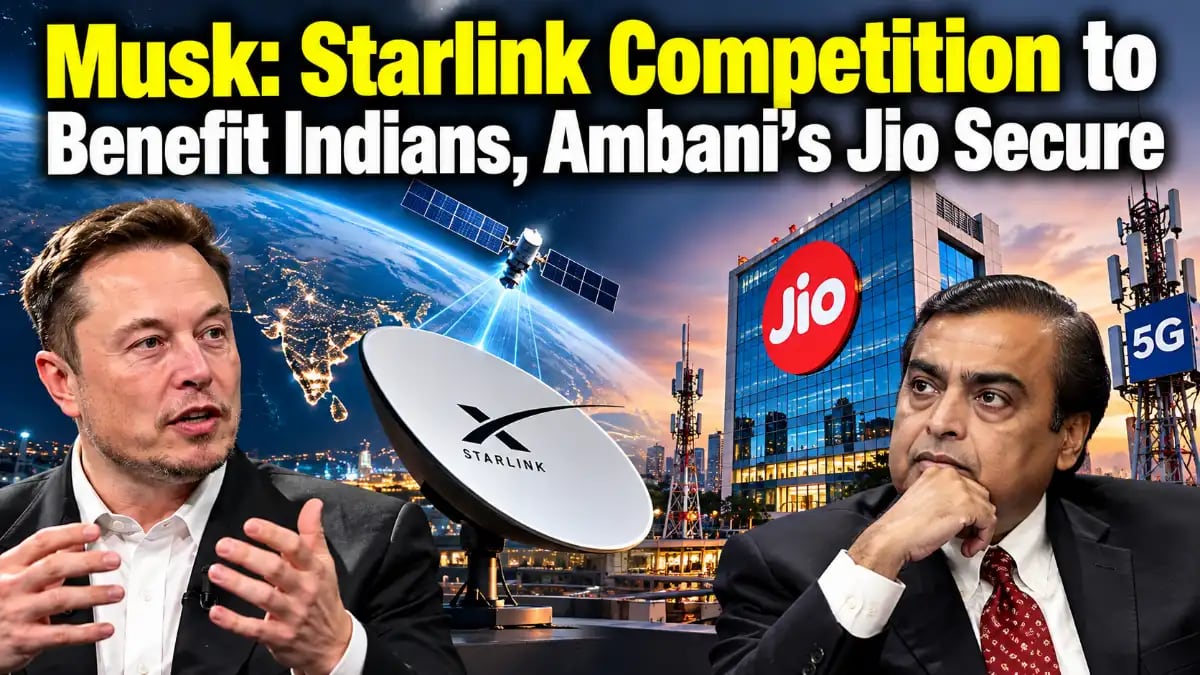

Musk: Starlink Competition to Benefit Indians, Ambani's Jio Secure
New Delhi, India – Elon Musk, the visionary behind SpaceX and Starlink, has emphatically stated that the entry of his satellite internet service into India would catalyze competition, ultimately benefiting millions of Indian consumers, while assuring that telecom titan Mukesh Ambani's Reliance Jio would remain a formidable player. Musk's comments underscore a brewing battle for connectivity in one of the world's largest and fastest-growing digital markets, pitting established terrestrial giants against a new frontier of space-based internet.
Speaking on the potential competitive landscape, Musk dismissed notions of a zero-sum game, remarking,
"Ambani won't go out of business. Competition is good, and it will benefit the people of India."
This sentiment signals Starlink's intent to penetrate the Indian market, not as a direct replacement for existing broadband, but as a complementary service, particularly in underserved and remote regions.
Starlink's Ambitious Foray and Regulatory Hurdles
Starlink, a division of SpaceX, aims to provide high-speed, low-latency broadband internet globally using a constellation of Low Earth Orbit (LEO) satellites. For India, a nation still grappling with significant digital disparities, Starlink presents a compelling proposition to bridge the connectivity gap in areas where laying fiber optic cables or establishing traditional cellular towers is economically unviable or geographically challenging. The company has already launched thousands of satellites, establishing a global footprint that promises internet access even in the most isolated locales.
However, Starlink's journey into India has been fraught with regulatory complexities. Initially, the company faced a setback in late 2021 when the Department of Telecommunications (DoT) directed it to refund pre-orders, citing the absence of a necessary license to operate in India. This highlighted the stringent regulatory environment and the government's cautious approach to new technologies and foreign players. Subsequent efforts have focused on securing the requisite approvals, including a Global Mobile Personal Communication by Satellite (GMPCS) licence, which is crucial for offering satellite-based communication services.
The Indian Telecom Arena: A Fiercely Contested Market
India's telecom sector is dominated by three major private players: Reliance Jio, Bharti Airtel, and Vodafone Idea. Reliance Jio, led by Mukesh Ambani, revolutionized the market with its aggressive pricing and widespread 4G rollout, accumulating over 470 million subscribers and significantly driving down data costs since its launch in 2016. Bharti Airtel, with its robust network and expanding 5G services, remains a strong competitor, while Vodafone Idea continues to navigate financial challenges.
The existing players have invested billions in terrestrial infrastructure, including extensive fiber optic networks and rapidly expanding 5G coverage. For instance, Reliance Jio has laid over 1.1 million kilometers of fiber optic cable across India, connecting over 7,500 towns and cities. Bharti Airtel also boasts a significant fiber backbone and a rapidly expanding 5G footprint, aiming to cover all urban areas by early 2024. These investments represent a formidable barrier to entry for any new player, terrestrial or satellite-based.
Jio's Counter-Strategy and Indigenous Satellite Ambitions
Mukesh Ambani's Reliance Jio is not resting on its laurels. Recognizing the potential of satellite communication, Jio Platforms, in collaboration with Luxembourg-based SES, has formed 'Jio Space Technology Limited.' This joint venture aims to deliver satellite-based broadband services in India, utilizing SES's medium Earth orbit (MEO) satellite technology. This strategic move positions Jio to counter Starlink directly, offering a hybrid approach that leverages both terrestrial and satellite infrastructure.
The competition is expected to spur innovation and potentially lead to a reduction in service costs, aligning with the government's 'Digital India' vision to ensure ubiquitous and affordable internet access. Analysts predict that while Starlink might capture a niche market in remote areas, its direct competition with Jio and Airtel in urban and semi-urban centers will be challenging given the incumbents' entrenched networks and pricing power.
Policy Implications and Consumer Benefits
The Indian government, through bodies like the Telecom Regulatory Authority of India (TRAI) and the DoT, plays a pivotal role in shaping this competitive landscape. Policy decisions regarding spectrum allocation, licensing fees, and foreign direct investment (FDI) norms will significantly influence the pace and scale of Starlink's deployment and the overall growth of the satellite internet sector. The government's focus remains on expanding digital inclusion, and any technology that aids this objective, while adhering to national security and regulatory frameworks, is likely to be encouraged.
- Increased Access: Satellite internet can reach areas inaccessible to traditional broadband.
- Price Competition: New entrants could drive down internet service costs.
- Service Quality: Competition often leads to improved network reliability and speeds.
- Technological Advancement: Encourages innovation in both terrestrial and satellite communication.
The unfolding scenario promises a dynamic evolution for India's digital infrastructure. While Ambani's empire is undeniably robust, Musk's Starlink represents a potent force capable of reshaping connectivity paradigms, ultimately empowering Indian citizens with more choices and better access to the global digital economy.
Frequently Asked Questions
Aniket More
Senior EditorAniket More is an editorial writer and journalist for Digital Bharat Times, specializing in verified news reporting, regional developments, and national policy analysis.















Comments (0)
Leave a Comment
No comments yet. Be the first to comment!