
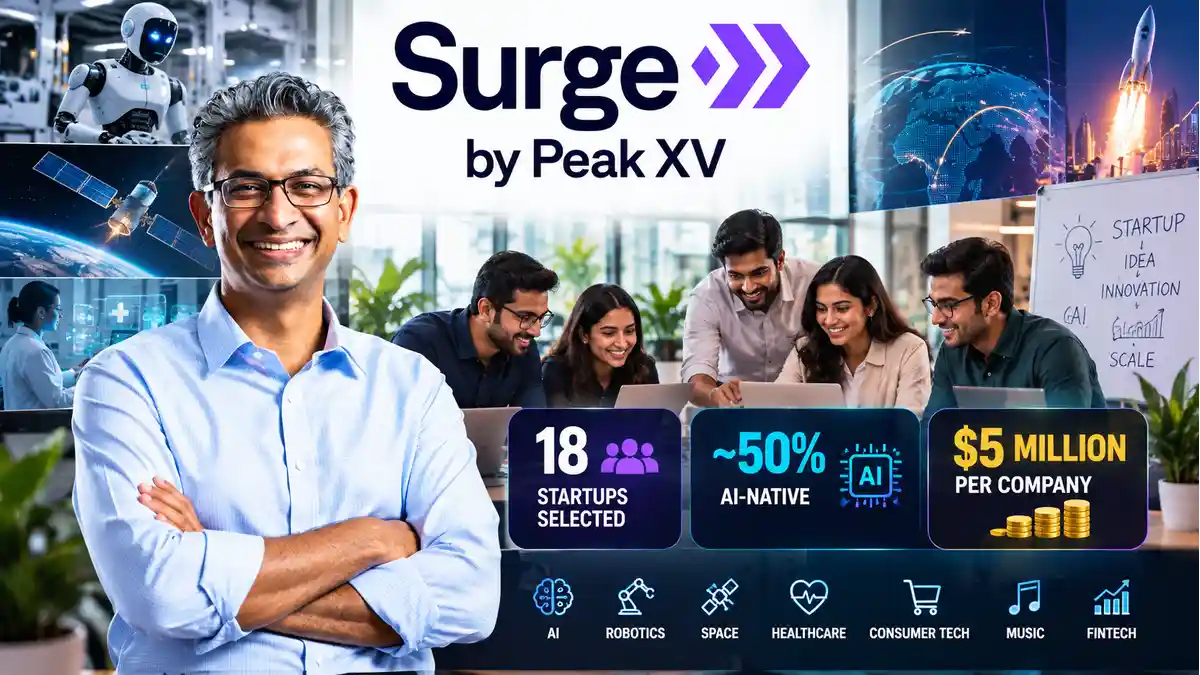

The venture capital playbook for early-stage technology companies is undergoing a structural realignment. Moving past the initial hype cycle of generative AI wrappers and basic chat interfaces, Peak XV Partners has introduced Surge 12, an 18-startup cohort that illustrates where institutional seed capital is concentrating. Backed by an aggregate seed pool exceeding $90 million—with Peak XV directly investing more than $50 million across the batch—the cohort reflects a critical operational pivot: artificial intelligence is no longer an optional product enhancement, but the baseline infrastructure powering physical-world robotics, radio-frequency orbital satellites, enterprise safety, and specialized healthcare delivery.
The Venture Angle: Seed Rounds Expand to $5 Million Cap
Surge 12 serves as the operational debut for Peak XV's revised seed policy, which officially increased its per-company check limit from $3 million to $5 million. This expansion responds to systemic market pressures across global venture corridors. As institutional Series A thresholds become more selective, early-stage ventures in compute-heavy AI, space exploration, and industrial robotics require substantial capital upfront to engineer prototypes, secure enterprise validation, and achieve operational viability before seeking growth equity.
According to Rajan Anandan, Managing Director at Peak XV and Surge, approximately half of the cohort consists of AI-native companies. These enterprises are not retrofitting legacy software with machine learning algorithms; their operational workflows, data pipelines, and unit economics are constructed around autonomous intelligence from inception.
"India has more consumer AI startups than the United States, and voice AI will emerge as a defining billion-dollar revenue category. But Surge 12 also proves that early-stage tech has expanded far beyond screens into specialized hardware, deep-tech robotics, and space intelligence."
AI Leaps Beyond Screens: Robotics, Satellites, and Physical Assets
The distinctive editorial angle of Surge 12 is the synthesis of cognitive algorithms with complex physical engineering. While general-purpose LLM interfaces dominate consumer headlines, founders are applying high-speed computing to heavy infrastructure and aerospace:
- Underground Pipe Robotics (Puralink): Autonomous robotic units built to navigate subterranean municipal and industrial piping networks to preempt structural failures.
- Orbital Spectrum Intelligence (ULOOK): Autonomous satellite constellations engineered for radio-frequency (RF) sensing, orbital spectrum monitoring, and aerospace data feeds.
- Enterprise AI Defense & Alignment (Reinforce Labs): Systems designed to stress-test, red-team, and remediate systemic vulnerabilities inside corporate AI deployments.
- Model Customization Rails (HiLoop): Developer infrastructure built to adapt and calibrate open-weight foundation models for specialized vertical applications.
- Hybrid Physician Delivery (August AI & Hoola Health): Platforms embedding clinical reasoning models directly alongside licensed medical practitioners across multi-country diagnostic and developmental therapy networks.
The 'Build in India, Sell to the World' Export Pipeline
Geographically, Surge 12 confirms a persistent cross-border trend. While more than half of the 18 startups maintain core engineering centers or headquarters in India, 13 companies target international enterprise and consumer markets, with only five dedicated strictly to the domestic Indian economy.
This dynamic reinforces India's evolution from a domestic consumer market into an international product foundry. Founders are capitalizing on local engineering depth to design exportable deep-tech IP for North American, European, and Asia-Pacific enterprise buyers. With Peak XV deploying capital from its multi-billion-dollar fund reserves, Surge 12 indicates that the next era of tech creation belongs to high-capital seed bets operating at the intersection of AI, hardware, and global infrastructure.
Frequently Asked Questions
Ketan
adminPassionate journalist and digital news editor committed to delivering accurate, timely, and fact-checked news.
Related Articles




Latest Articles

Trump, Tech Giants Ink Voluntary AI Pact Amid Glob...
Oct 01, 2026
Khanna Targets 'Recursive' AI with Landmark Safety...
Oct 01, 2026
Election Commission–SIR Row: INDIA Bloc Announces...
Oct 01, 2026
WHO Unveils Critical Global Guidance to Combat Hea...
Oct 01, 2026
Comments (0)
Leave a Comment
No comments yet. Be the first to comment!