
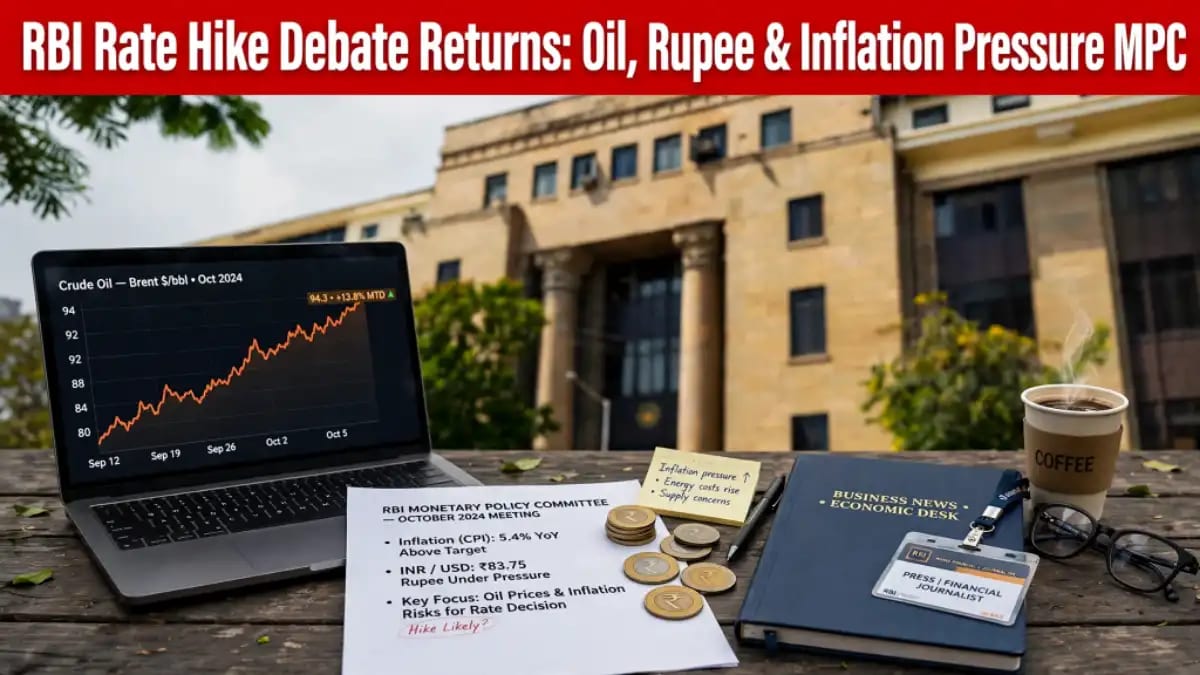

NEW DELHI: The debate over an RBI rate hike has returned ahead of the Monetary Policy Committee's October 5–7 meeting, but this time the pressure is coming from more than one direction. Inflation has started broadening, crude oil prices have risen sharply, the rupee remains under pressure and global financial conditions have become less comfortable.
Against this backdrop, SBI Research has argued that the Reserve Bank of India may need to raise the policy repo rate by 25 basis points at its October meeting. The recommendation marks a significant change in the monetary-policy conversation that earlier in 2026 focused on growth support.
RBI Has Not Announced a Rate Hike Yet
The first distinction is important. The RBI's repo rate currently stands at 5.25%. The central bank kept it unchanged during its last four policy reviews after cutting rates by cumulative 125 bps in 2025. The next decision will be announced after the six-member MPC meets from October 5 to October 7. Therefore, a 25-bps hike remains an expectation, not a decision already taken.
Why Has the Rate-Hike Discussion Returned?
India's retail inflation increased from 4.45% in July to 4.82% in August 2026. SBI Research believes pressure could intensify, putting September CPI at around 5.65%, with inflation potentially exceeding 6.5% during October and November before moderating below 6% in early 2027. These are forecasts, but they matter because RBI's target is 4% with tolerance band up to 6%.
Crude Oil Has Changed the Equation
India is heavily dependent on imported crude. The Finance Ministry's September 2026 Monthly Economic Review warned that elevated crude prices and geopolitical tensions could increase imported inflation, while adding pressure to rupee and capital flows. SBI Research has identified higher crude as one factor that could push inflation above RBI's earlier projections.
The Rupee Is Another Pressure Point
The rupee has weakened by around 6% against USD in 2026, as per Reuters via Business Standard. A weaker rupee makes imported commodities more expensive and amplifies inflation impact of higher oil prices. A narrower interest-rate differential with US can also influence foreign capital flows.
Liquidity - The Less Visible Story
SBI Research argues headline liquidity figures do not tell entire story. Regulatory requirements such as CRR, SLR and LCR influence how much deposit money banks can convert into credit. RBI has also been using open-market operations to manage surplus liquidity. Finance Ministry noted these operations could help maintain balanced financial conditions.
Why Businesses Should Watch
For businesses, important issue is cost of capital. Higher repo rate can transmit into lending rates. Companies refinancing existing debt could face higher financing costs. Impact would not be immediate or uniform as banks differ in funding structures.
What Could Happen to Borrowers and Depositors?
For retail borrowers with floating-rate loans, if banks pass repo hike, borrowers could face higher EMI or longer tenure. However one 25 bps hike does not automatically mean every loan EMI rises same amount. For depositors, banks facing tighter liquidity may eventually offer more competitive deposit rates.
What to Watch on October 7
Markets will watch 5 indicators: 1) Repo-rate decision 2) RBI's inflation forecast 3) FY27 growth assessment 4) View on crude oil and imported inflation 5) Guidance on liquidity and rupee. Together these will provide more info than headline rate alone. SBI expects RBI to raise FY27 GDP growth forecast by 30 bps while raising inflation forecast by 20 bps.
Frequently Asked Questions
Ketan
Editor-in-ChiefPassionate journalist and digital news editor committed to delivering accurate, timely, and fact-checked news.















Comments (0)
Leave a Comment
No comments yet. Be the first to comment!