
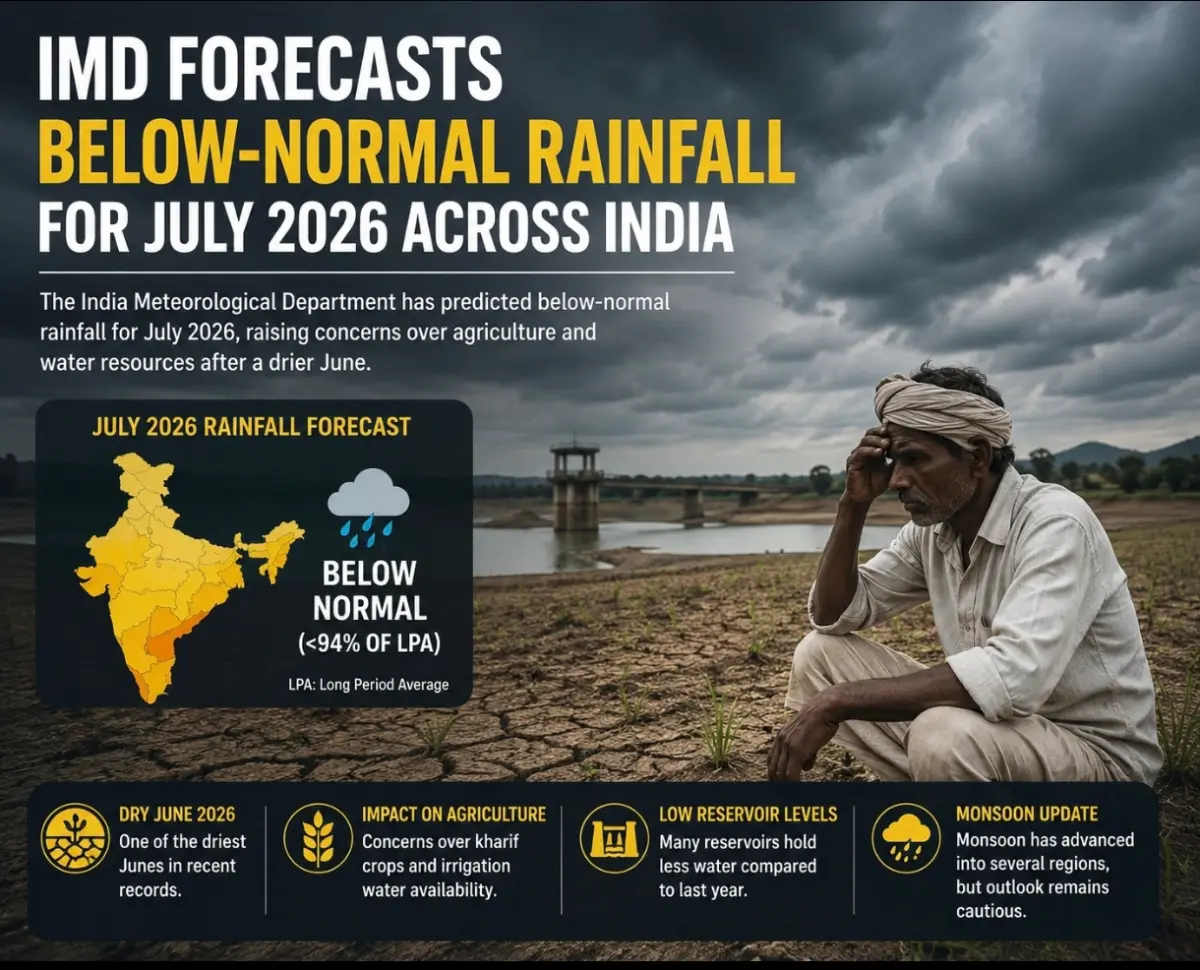

IMD Issues Below-Normal Rainfall Warning for July
New Delhi: The India Meteorological Department (IMD) has forecasted below-normal rainfall for July 2026, the most critical month for the southwest monsoon season. According to IMD Director-General Mrutyunjay Mohapatra, rainfall is likely to be less than 94 per cent of the long-period average (LPA). This development comes after June 2026 recorded significantly below-average precipitation, marking it as one of the driest Junes in recent records.
The forecast has triggered concerns among farmers, policymakers, and water resource managers across the country. July typically accounts for a substantial portion of the annual monsoon rainfall, playing a vital role in replenishing reservoirs and supporting kharif crop cultivation.
Current Monsoon Situation and Regional Variations
While the southwest monsoon has made progress, advancing into parts of Gujarat, Madhya Pradesh, Rajasthan, Haryana, and Delhi, the overall distribution remains uneven. Delhi recorded its first July monsoon arrival in five years, bringing some relief with thunderstorms and showers. However, many other regions continue to face rainfall deficits.
The IMD has noted that while some areas may receive normal or above-normal rains, large parts of central and northwest India are expected to experience deficient rainfall. This uneven pattern could exacerbate challenges for rain-fed agriculture, which constitutes a major portion of farming in the country.
Potential Impact on Agriculture and Economy
India’s agriculture sector, which employs a significant portion of the population, relies heavily on timely and adequate monsoon rains. A below-normal July could delay sowing or affect the growth of key kharif crops such as rice, maize, cotton, and pulses. Government officials are already preparing contingency plans, including alternative irrigation support and crop insurance measures.
Reservoir levels in many states are currently lower compared to the same period last year. This raises worries about drinking water supply and power generation in the coming months, particularly if the deficit persists.
Causes and Broader Context
Experts attribute the current weak monsoon phase to various climatic factors, including the lingering effects of previous weather patterns. The IMD continues to monitor developments closely and issues regular updates.
Historically, below-normal monsoon years have posed challenges to food security and economic growth. However, improved irrigation infrastructure and diversified cropping patterns in recent years may help mitigate some risks.
Government and Farmer Preparedness
The Union Agriculture Ministry and state governments are advising farmers to adopt water-efficient practices and consider short-duration crop varieties. Weather advisories are being disseminated through various channels to help stakeholders make informed decisions.
As the monsoon season progresses, the situation will be closely watched. The first week of July has brought some rainfall in certain regions, but the overall monthly outlook remains cautious.
Digital Bharat Times will continue to provide updates on monsoon developments and their impact on different sectors.
Frequently Asked Questions
Ketan
adminPassionate journalist and digital news editor committed to delivering accurate, timely, and fact-checked news.
Related Articles



Latest Articles

Trump, Tech Giants Ink Voluntary AI Pact Amid Glob...
Oct 01, 2026
Khanna Targets 'Recursive' AI with Landmark Safety...
Oct 01, 2026
Election Commission–SIR Row: INDIA Bloc Announces...
Oct 01, 2026
WHO Unveils Critical Global Guidance to Combat Hea...
Oct 01, 2026
Comments (0)
Leave a Comment
No comments yet. Be the first to comment!