
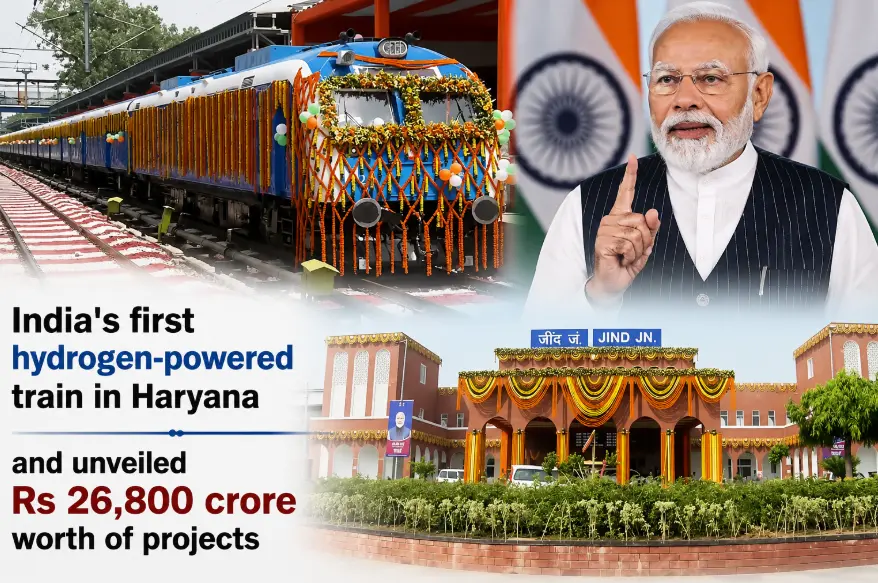

This article covers PM Narendra Modi's flag-off of India's first hydrogen-powered train on the Jind-Sonipat route in Haryana, detailing the train's fuel cell technology, safety systems and scale, alongside the wider Rs 26,800 crore infrastructure tour across Haryana, Chandigarh and Punjab.
- PM Modi flagged off India's first hydrogen-powered train on the Jind-Sonipat route in Haryana.
- The 10-coach, 2,600-seat train is among the world's largest hydrogen trains, far bigger than similar projects abroad.
- It runs on PEM fuel cell technology, emitting only water vapour with zero carbon output.
- The visit also included the launch of Rs 26,800 crore worth of projects across Haryana, Chandigarh and Punjab.
- The tour is widely seen as the start of the BJP's outreach ahead of Punjab's 2027 assembly elections.
PM Modi Flags Off India's First Hydrogen-Powered Train in Haryana
Prime Minister Narendra Modi on Friday flagged off India's first indigenously developed hydrogen-powered passenger train from Jind railway station in Haryana, marking a landmark moment for the country's push toward sustainable, zero-emission rail travel. The launch was the centrepiece of a packed, day-long tour that also took the Prime Minister through Chandigarh and Punjab, where he unveiled infrastructure projects worth roughly Rs 26,800 crore.
A Green Milestone for Indian Railways
The hydrogen train will operate on the 89-km Jind-Sonipat section of the Northern Railway, running through Gohana and several intermediate stations. Unlike conventional electric trains that draw power from overhead wires, this train generates its own electricity onboard through a Proton Exchange Membrane (PEM) fuel cell, where hydrogen reacts with oxygen to produce power. The only by-products of this process are water vapour and heat, making the train entirely emission-free.
According to officials, the train carries its own onboard source of power in the same spirit as the steam and diesel locomotives of the past, but without any combustion or reliance on external power infrastructure. It has an operational speed of 75 kmph and a top design speed of 110 kmph, striking a balance between sustainability and everyday efficiency.
India Goes Big Where Others Went Small
What sets India's effort apart from similar projects in Germany, France and China, where hydrogen trains have largely been limited to two-to-four coach regional services, is scale. India's version is a full 10-coach passenger train with a seating capacity of around 2,600 passengers, making it one of the longest and most powerful hydrogen trains built anywhere in the world. Officials say this demonstrates that hydrogen technology can be scaled up for high-density passenger operations, not just experimental short routes.
Safety has been a major focus of the project. The train is equipped with multi-layer detection systems capable of identifying hydrogen leaks, heat, flames and smoke, along with automatic shut-off valves and continuous ventilation to disperse any leaked gas safely. Loco pilot cabins have been specially designed with real-time monitoring systems and emergency response modes. Matching safety infrastructure, including leak detectors and fire suppression systems, has also been installed at the country's largest railway hydrogen refuelling facility, built specifically for this project at Jind.
Together, these elements make up what officials are calling India's first fully integrated hydrogen rail ecosystem, spanning rolling stock, hydrogen storage, dispensing infrastructure and operational protocols. The Jind-Sonipat corridor was chosen specifically to test the technology's viability, safety and reliability under real-world, everyday service conditions before any wider rollout.
Building on Railways' Electrification Push
The hydrogen train initiative builds on Indian Railways' broader modernisation drive, which has already seen over 99 percent of broad gauge routes electrified nationwide. With the Jind-Sonipat pilot underway, officials have signalled that hydrogen trains could eventually be deployed on other routes, including scenic heritage lines such as the Kalka-Shimla railway, where zero-emission travel could complement tourism goals.
A Broader Push: Rs 26,800 Crore in Projects Across Three States
The hydrogen train launch was only one part of a much larger day for the Prime Minister, who travelled onward to Chandigarh and Punjab to inaugurate or lay the foundation stone for a wide range of infrastructure projects.
In Haryana alone, at Jind's Eklavya Stadium, Modi launched projects worth close to Rs 14,700 crore, covering road and rail connectivity between Delhi and Amritsar, the Ambala-Kala Amb highway linking Haryana with Himachal Pradesh, the Jind-Gohana Greenfield Highway (which cuts travel time on the route from nearly two hours to about 40 minutes), and the Kurukshetra Elevated Railway Track aimed at easing traffic congestion. He also dedicated new medical colleges in Bhiwani and Narnaul to the nation and laid the foundation stone for a Sikh Museum in Kurukshetra, intended to showcase Sikh history and the teachings of the Gurus.
In Chandigarh, the Prime Minister unveiled projects worth over Rs 4,700 crore, with healthcare and education taking centre stage, including works linked to PGIMER, alongside road connectivity upgrades such as a new spur on the Ambala-Chandigarh Greenfield Highway to improve access to the Chandigarh airport area.
The final leg of the tour took Modi to Jalandhar in Punjab, where he inaugurated or laid the foundation stone for projects worth roughly Rs 5,470 crore, and formally opened 75 redeveloped railway stations across the country under the Amrit Bharat Station Scheme.
Why It Matters
Beyond the technological milestone, the visit carries clear political weight. With Punjab headed to assembly elections in early 2027, the tour is widely seen as marking the start of the BJP's outreach in the state, with Modi framing the development push around connectivity, healthcare, culture and education as work that will particularly benefit the states youth. Taken together, the day's announcements mark one of the most significant single-day infrastructure rollouts in the region in recent years, combining a genuine technological first with a wide-ranging development push across three states.
Frequently Asked Questions
Admin
adminPassionate journalist and digital news editor committed to delivering accurate, timely, and fact-checked news.
Related Articles
Latest Articles
E20 Janta Party: New Online Movement Demands Pure...
Jul 28, 2026
Anti-Paper Leak Bill Tabled in Lok Sabha, Debate o...
Jul 28, 2026
Nvidia in Talks for $250 Billion OpenAI Data Cente...
Jul 27, 2026
Mirabai Chanu Wins Historic Third Straight CWG Gol...
Jul 27, 2026
Comments (0)
Leave a Comment
No comments yet. Be the first to comment!