
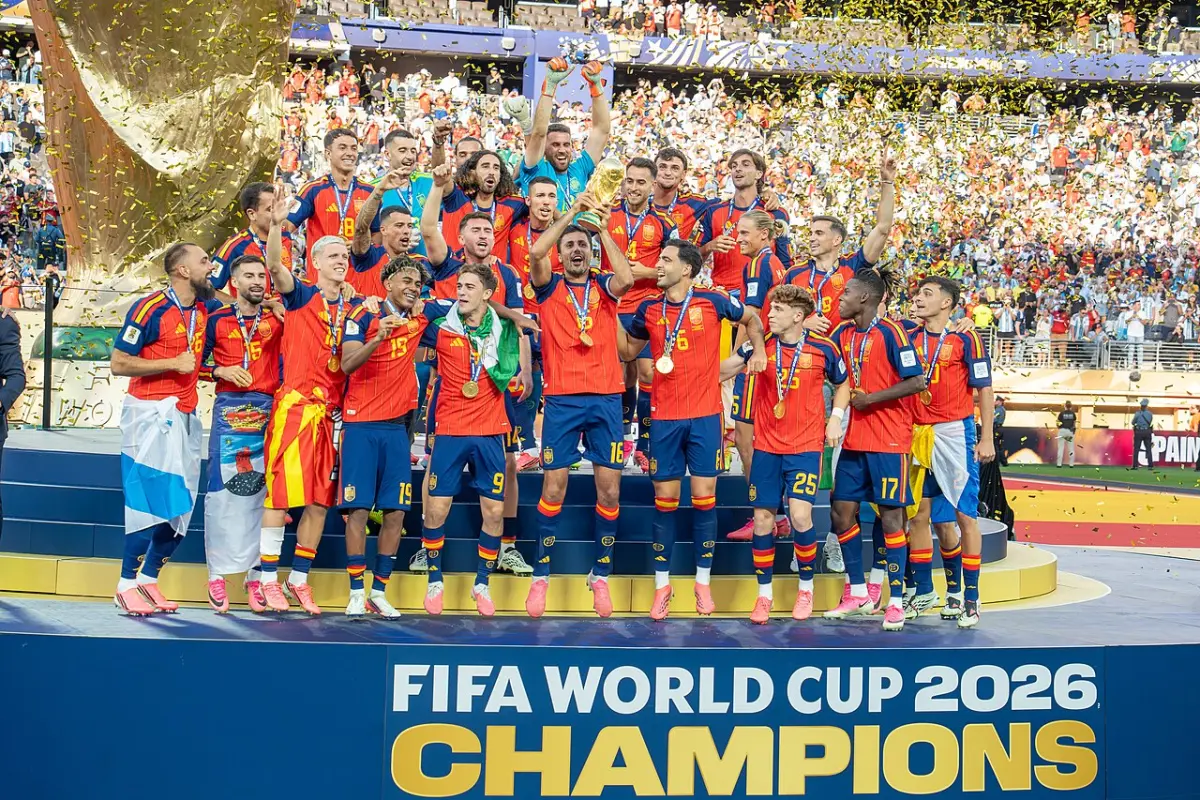

Spain won their second World Cup title, beating defending champions Argentina 1-0 in extra time at MetLife Stadium, with substitute Ferran Torres scoring the decisive goal in the 106th minute to cap the most defensively dominant campaign in World Cup history, conceding just one goal across the entire tournament.
- Spain won the World Cup 2026 final 1-0 in extra time against Argentina at MetLife Stadium.
- Substitute Ferran Torres scored the winning goal in the 106th minute.
- Spain conceded just one goal across the entire tournament, the best defensive record by any champion in World Cup history.
- Argentina's Emiliano Martinez made 11 saves in the final, the most ever in a men's World Cup final.
- England finished third after beating France 6-4, with Kylian Mbappe finishing as the tournament's all-time top World Cup scorer.
- Spain extended their unbeaten run to 38 consecutive matches, including their Euro 2024 title.
Spain Crowned World Cup 2026 Champions
Spain won the FIFA World Cup for the second time in their history, beating defending champions Argentina 1-0 after extra time in the final at MetLife Stadium in East Rutherford, New Jersey, on Sunday. The victory brought North America's first men's World Cup in over three decades to a close and denied Argentina the chance to become the first back-to-back champions since Brazil in 1958 and 1962.
Ferran Torres Delivers the Decisive Blow
The match remained goalless through 90 minutes of tightly contested football, with Argentina's defence, marshalled by goalkeeper Emiliano Martinez, repeatedly denying Spain's attacking pressure. Martinez finished the match with 11 saves, the most recorded by any goalkeeper in a men's World Cup final. Spain's breakthrough finally came in the 106th minute of extra time, when substitute Ferran Torres netted the winner, becoming only the second substitute in World Cup final history to score the winning goal.
A Historically Dominant Defensive Campaign
Spain's triumph capped the most defensively dominant World Cup-winning campaign ever recorded, with the team conceding just one goal across the entire tournament, a record no previous champion has matched. Spain dominated possession throughout the final, holding 60 percent of the ball and restricting Argentina to zero shots and only two touches inside Spain's penalty area through the first half of extra time.
Argentina's Golden Generation Falls Short
For Argentina, the defeat ends their bid to become the first nation to win consecutive World Cups since Brazil more than six decades ago. It is widely expected to be Lionel Messi's final World Cup appearance, as he will be 43 by the time the 2030 tournament is held, though Messi has previously suggested the 2022 tournament might be his last before going on to lead Argentina to this final. After the match, Messi was seen congratulating Spain's breakout star Lamine Yamal, who has often been described as his heir apparent on the international stage.
Spain's Path to a Second Title
Spain's win echoes their first World Cup triumph in 2010, when Andres Iniesta scored the decisive goal in the 116th minute of the final against the Netherlands. This year, Spain reached the final after a commanding 2-0 semifinal win over France, while Argentina advanced with a dramatic 2-1 comeback victory over England, scoring twice late in the match to complete the turnaround.
England Take Third, Mbappe Ends as Top Scorer
England claimed third place on Saturday with a wild 6-4 win over France, with Bukayo Saka scoring a hat-trick and Jude Bellingham sealing the win in stoppage time. Despite the defeat, France's Kylian Mbappe scored twice to finish as the tournament's all-time leading World Cup scorer.
A Final Watched by World Leaders
The trophy presentation was attended by a delegation including US President Donald Trump, Mexican President Claudia Sheinbaum, and Canadian Prime Minister Mark Carney, representing the three nations that co-hosted the tournament. Spain captain Rodri lifted the trophy in front of a crowd of more than 80,000 spectators at MetLife Stadium, capping a run in which Spain extended their unbeaten streak to 38 consecutive matches, a run that also includes their UEFA Euro 2024 title.
Frequently Asked Questions
Admin
adminPassionate journalist and digital news editor committed to delivering accurate, timely, and fact-checked news.
Related Articles

Latest Articles

E20 Janta Party: New Online Movement Demands Pure...
Jul 28, 2026
Anti-Paper Leak Bill Tabled in Lok Sabha, Debate o...
Jul 28, 2026
Nvidia in Talks for $250 Billion OpenAI Data Cente...
Jul 27, 2026
Mirabai Chanu Wins Historic Third Straight CWG Gol...
Jul 27, 2026
Comments (0)
Leave a Comment
No comments yet. Be the first to comment!