
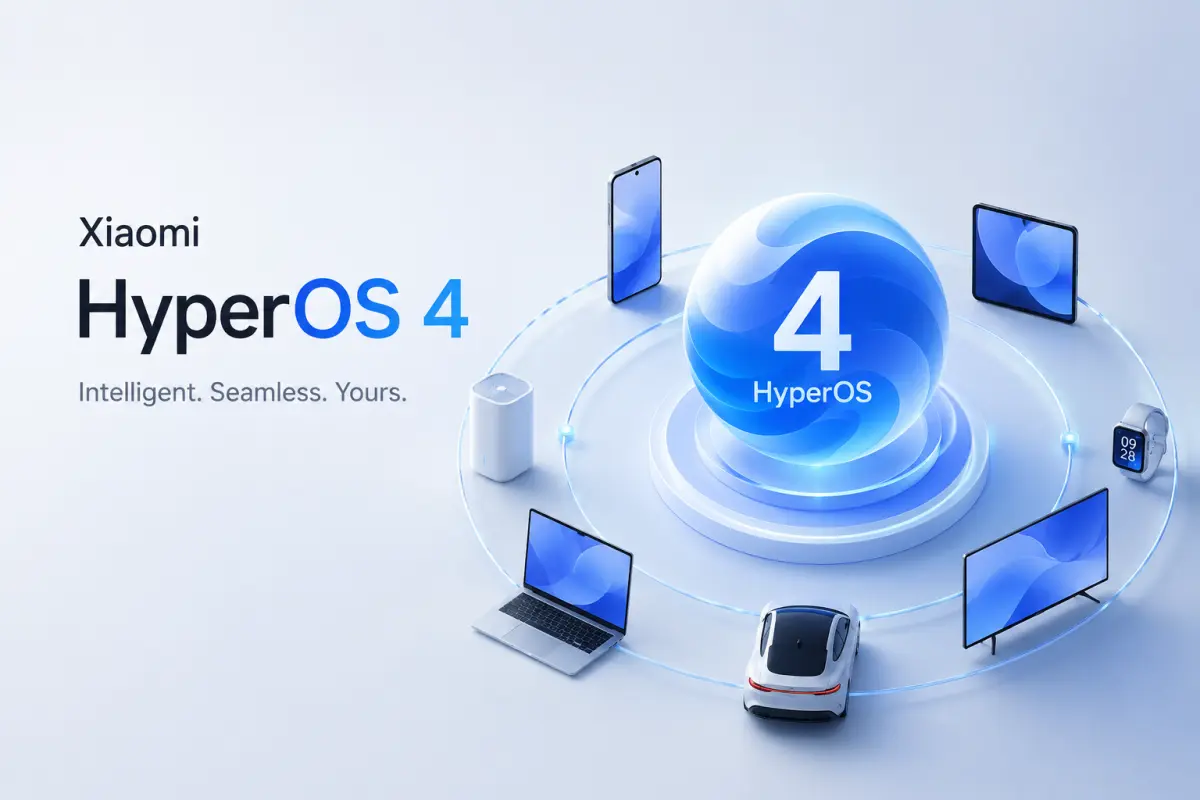

Xiaomi's HyperOS 4 is reportedly set to launch in China in August 2026, built entirely on Rust and Flutter with claims of significant performance improvements, faster cross-device file transfers, and a fully offline on-device AI suite. Global rollout is expected to follow within weeks.
- HyperOS 4 is reportedly launching in China in August 2026, timed with the Xiaomi 18 series.
- It is said to be Xiaomi's first OS built on a completely clean-sheet architecture using Rust and Flutter.
- Internal figures claim 40% smoother performance and just 5% degradation after a year of use.
- File transfer speeds between Xiaomi devices could improve by up to 300%.
- A fully offline AI suite, Mimo and Miclaw, is expected to handle tasks without needing an internet connection.
- Global rollout is expected roughly four to six weeks after the China launch.
HyperOS 4 Launch Window Reportedly Confirmed
Xiaomi's next major software update, HyperOS 4, is reportedly set for an August 2026 launch in China, according to multiple Chinese industry insiders. The rollout is expected to coincide with the debut of the Xiaomi 18 series, or possibly the upcoming Mix Fold 5. A global rollout is expected to follow roughly two months later, consistent with the timeline Xiaomi followed for HyperOS 3.
Built Entirely on Rust and Flutter
According to the reports, HyperOS 4 marks the first time Xiaomi has built an operating system on a completely clean-sheet architecture, dropping the last remnants of legacy MIUI code. The system is said to be built using Rust and Flutter, with Rust's memory-safety model intended to eliminate entire categories of bugs common in older Android skins built on legacy C or C++ frameworks. Flutter is reportedly being used to maintain consistent interface rendering across Xiaomi's full device ecosystem, including phones, tablets, TVs, and vehicles, from a single codebase.
Specific Performance Claims Surface
Unlike typical pre-launch software announcements that rely on vague marketing language, early internal figures cited in the reports include specific performance claims: a 40 percent improvement in system smoothness, 35 percent better background app retention, and 25 to 30 percent lower idle memory usage. Xiaomi is also said to be targeting no more than 5 percent performance degradation after a full year of use, an unusually aggressive target aimed at addressing long-standing complaints about Android phones slowing down over time.
These figures are based on Xiaomi's internal testing rather than independent third-party benchmarks, and should be treated as unverified claims until HyperOS 4 is tested publicly after launch.
Faster Cross-Device Transfers and Offline AI
File transfer speeds between Xiaomi devices could reportedly increase by up to 300 percent under HyperOS 4, alongside improved app continuity that would let users resume a task on one device, such as a phone, and pick it up seamlessly on a tablet or PC. Xiaomi previously demonstrated a version of this feature with HyperOS 3, though the implementation was inconsistent at the time.
The update is also expected to introduce a fully offline on-device AI suite, reportedly built around two systems: Mimo, aimed at document summarisation and translation, and Miclaw, aimed at agent-based tasks. Because processing happens entirely on the device rather than through a cloud connection, response times are expected to be faster, and the features are expected to work without an internet connection.
Who Gets HyperOS 4 First
According to leaks attributed to tipster Digital Chat Station, the first beta testers in China are expected to be owners of the Xiaomi 17 series and Redmi K90. The stable rollout is expected to begin with the Xiaomi 18 and 18 Pro Max in September, before expanding to the Xiaomi 15, Xiaomi 14, and Redmi K90 series by the end of the year. Global devices typically receive HyperOS updates four to six weeks after the China rollout begins.
What This Means for Users
If the reported figures hold up after launch, HyperOS 4 would represent one of Xiaomi's most significant software overhauls in recent years, particularly around long-term device performance and privacy-focused on-device AI. However, as with all pre-launch leaks, the final feature set and performance figures could change before the official announcement.
Frequently Asked Questions
Admin
adminPassionate journalist and digital news editor committed to delivering accurate, timely, and fact-checked news.
Related Articles



Latest Articles

E20 Janta Party: New Online Movement Demands Pure...
Jul 28, 2026
Anti-Paper Leak Bill Tabled in Lok Sabha, Debate o...
Jul 28, 2026
Nvidia in Talks for $250 Billion OpenAI Data Cente...
Jul 27, 2026
Mirabai Chanu Wins Historic Third Straight CWG Gol...
Jul 27, 2026
Comments (0)
Leave a Comment
No comments yet. Be the first to comment!