
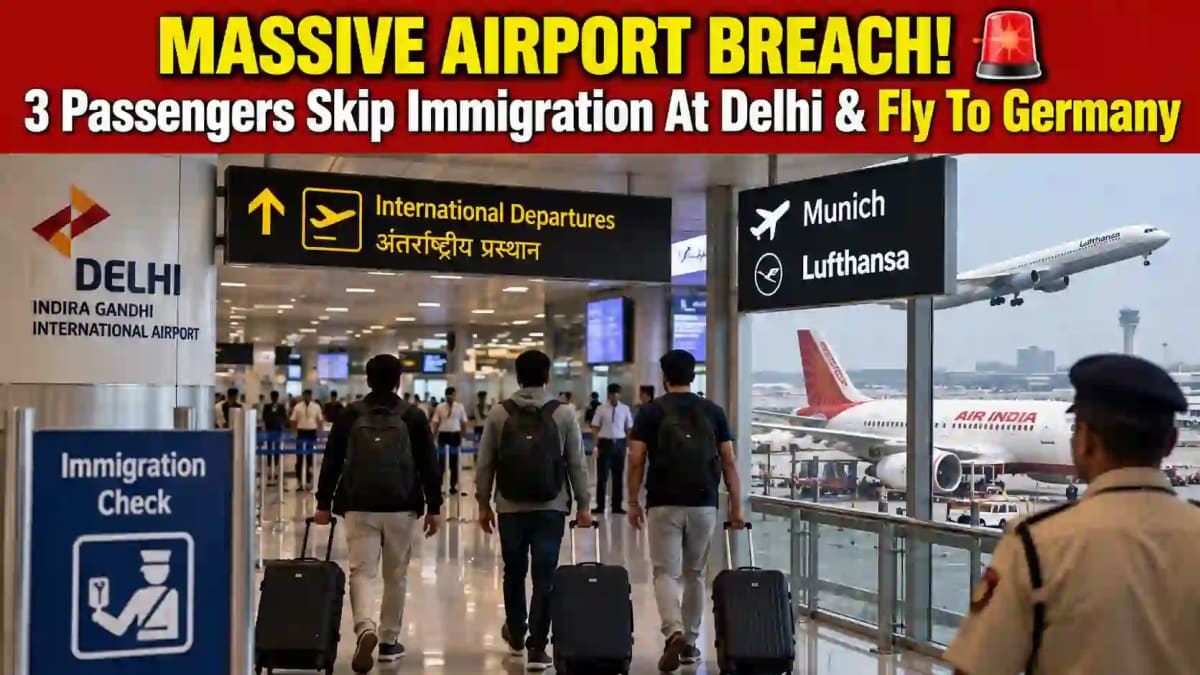

New Delhi: In a major cross-border security and civil aviation compliance breach, the Ministry of Civil Aviation (MoCA) has issued a formal show-cause notice to Air India Chief Executive Officer Campbell Wilson after three foreign nationals arriving on a domestic flight from Amritsar bypassed mandatory departure immigration at Indira Gandhi International (IGI) Airport and flew to Munich, Germany. The incident occurred during the early hours of September 4, 2026, when the passengers transited directly through Terminal 3 without biometric logging, passport profiling, or security clearance by the Bureau of Immigration (BoI). The regulatory lapse has triggered high-level government intervention, with Union Home Secretary Govind Mohan convening an urgent inter-agency security review involving the Ministry of Home Affairs (MHA), the Intelligence Bureau (IB), ground handler AISATS, and airport operator Delhi International Airport Limited (DIAL). For official civil aviation circulars, regulatory advisories, and security mandates, visit the Ministry of Civil Aviation Official Portal.
Anatomy of the Breach: The Amritsar–Delhi–Munich Corridor
Official investigation records indicate that the statutory lapse unfolded across a compressed interline transit window:
- The Domestic Inflow: The three passengers—identified as Italian nationals Surjit Singh, Balwinder Kaur, and Gurdev Singh—commenced their journey at Sri Guru Ram Dass Jee International Airport in Amritsar aboard Air India domestic flight AI-1115, touching down at Terminal 3 of Delhi’s IGI Airport at 00:50 hrs.
- The Codeshare Connection: The trio held confirmed connecting bookings from Delhi to Munich aboard Lufthansa flight LH-763, scheduled for departure less than an hour later at 01:45 hrs, utilizing the interline ticketing partnership between Air India and Lufthansa.
- The Unvetted Boarding: Despite originating their itinerary on an unsterilized domestic leg, the three passengers boarded the foreign flight without passing through central immigration, having their physical travel documents verified, or undergoing facial recognition recording by immigration authorities.
How the Protocol Collapsed: The 'D' Boarding Pass Misrouting
The regulatory show-cause notice dated September 12 outlines an operational failure by airline and ground-handling teams:
- The 'D' Boarding Pass Mandate: During check-in at Amritsar, the passengers were issued 'D' (Domestic) boarding passes for AI-1115 alongside onward connecting passes for the Lufthansa leg. Under established civil aviation Standard Operating Procedures (SOPs), any passenger holding a domestic boarding pass who arrives at a transit hub must be escorted into the main arrival concourse to formally clear international departure immigration.
- Misdirection into I-to-I Sterile Transit: Instead of guiding the trio toward landside immigration processing, ground handling personnel from Air India and AISATS routed the group into the 'International-to-International' (I-to-I) sterile transfer corridor. Because this corridor is designed exclusively for inbound international arrivals connecting outward to third countries, it completely bypasses domestic-to-international immigration checkpoints.
- Boarding Gate Verification Lapses: At the international departure gate, secondary boarding scanners and airline gate agents failed to identify the absence of mandatory Bureau of Immigration exit validation stamps, allowing the passengers to board the aircraft unimpeded.
The 'Hub-and-Spoke' Operational Loophole
Air India operates a specialized 'Easy Connect Hub-and-Spoke' program permitting select domestic passengers to clear customs and immigration at origin stations before boarding transit flights via Delhi. However, MoCA emphasized that this specific itinerary did not qualify for origin-level clearance. Because the onward long-haul leg was operated by an external partner airline (Lufthansa) and booked under standard domestic-to-international ticketing structures, mandatory exit controls were required at Delhi Airport. Ground personnel's failure to differentiate between eligible hub-and-spoke fliers and standard transfer passengers exposed an unmonitored exit path.
Inter-Agency Accountability and National Security Concerns
The unauthorized departure of individuals from an international hub presents significant border-control risks:
- Regulatory Repercussions: MoCA demanded that Air India submit a comprehensive written explanation within seven days, cautioning that failure to adhere to statutory security guidelines may attract financial penalties, review of ground-handling privileges, or formal action under the Aircraft Rules.
- Watchlist and Lookout Bypasses: Aviation security analysts noted that skipping immigration prevents real-time passenger cross-checks against the Central Passenger Name Record (CPNR), the National Automated Fingerprint Identification System (NAFIS), and inter-agency watchlists (such as Look Out Circulars or Interpol red notices) deployed to intercept fugitives or economic offenders.
- Internal Reconciliation Anomalies: Because foreign nationals leaving without biometric logging remain registered as active in internal databases, such lapses create reconciliation discrepancies across border management systems.
- Security Audit of Terminal 3: The Ministry of Home Affairs has directed DIAL, CISF, and airport stakeholders to audit passenger corridor access-control infrastructure, electronic security gates, and physical segregation barriers to prevent passenger cross-flows between domestic and international zones.
Frequently Asked Questions
Ketan
adminPassionate journalist and digital news editor committed to delivering accurate, timely, and fact-checked news.
Related Articles



Latest Articles

Trump, Tech Giants Ink Voluntary AI Pact Amid Glob...
Oct 01, 2026
Khanna Targets 'Recursive' AI with Landmark Safety...
Oct 01, 2026
Election Commission–SIR Row: INDIA Bloc Announces...
Oct 01, 2026
WHO Unveils Critical Global Guidance to Combat Hea...
Oct 01, 2026
Comments (0)
Leave a Comment
No comments yet. Be the first to comment!