
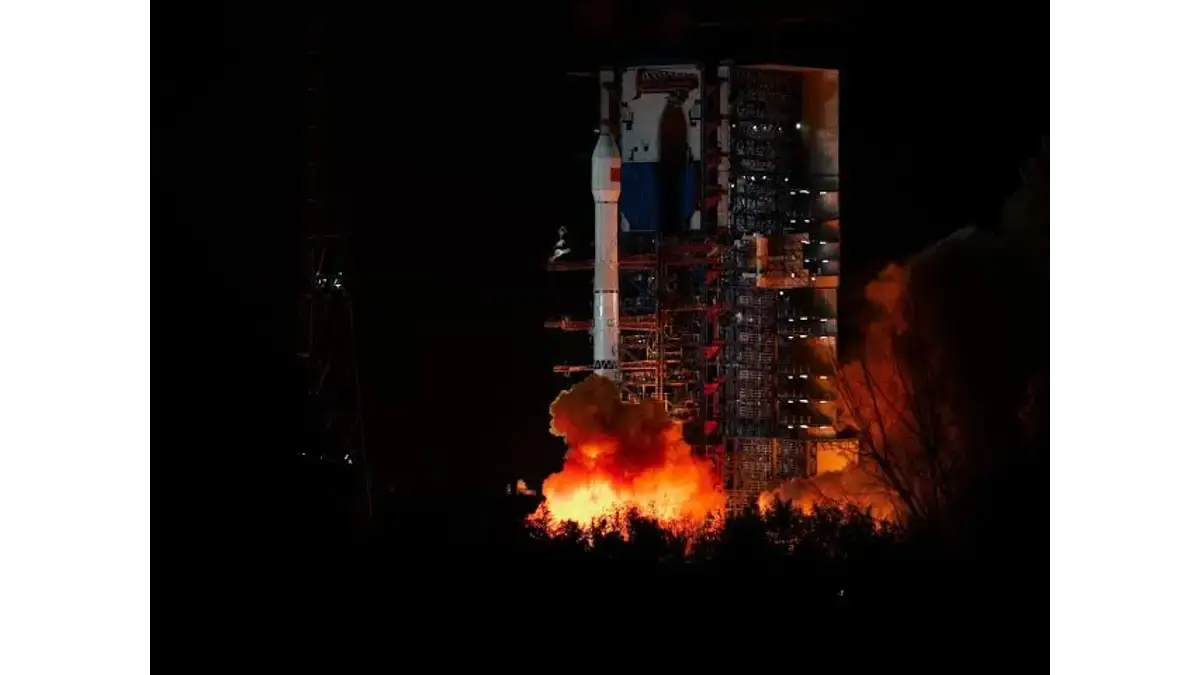

Wenchang, Hainan: China's space program suffered a major setback when a Long March 7A rocket carrying the advanced ChinaSat-4B communications satellite experienced a catastrophic failure shortly after launch. According to preliminary mission reports, the rocket encountered an unexpected in-flight anomaly and exploded approximately 85 seconds after liftoff from the Wenchang Space Launch Site on Hainan Island. For more global space exploration news and updates, visit our international breaking news hub.
Catastrophic Anomaly During Early Flight Phase
The mission was designed to place the ChinaSat-4B satellite into a Geostationary Transfer Orbit (GTO) to boost regional satellite telecommunication and broadcast services. However, telemetry data indicated a sudden deviation from the planned flight trajectory just past the one-minute mark, followed by a total loss of signal and subsequent mid-air breakup over the sea.
Eyewitnesses near the Wenchang coastal viewing areas reported seeing a bright flash and multiple trail fragments in the sky shortly after the rocket cleared the lower atmosphere, confirming an in-flight breakup.
Impact on ChinaSat-4B and Space Program Timeline
The loss of the ChinaSat-4B payload represents a significant financial and technological blow to state-owned operator China Satellite Communications. The satellite was intended to provide critical high-throughput communication coverage across the Asia-Pacific region. Space authorities have established an investigation committee to analyze telemetry and debris recovery data to determine whether the anomaly originated in the liquid-fueled boosters or the first-stage propulsion system.
Re-evaluating the Long March 7A Reliability
The Long March 7A is a three-and-a-half-stage medium-lift launch vehicle designed to handle China's geostationary payload demands. While previous launches had seen high success rates, this failure is expected to temporarily ground upcoming Long March 7A missions while engineers conduct a thorough root-cause investigation.
Frequently Asked Questions
Ketan
adminPassionate journalist and digital news editor committed to delivering accurate, timely, and fact-checked news.
Related Articles




Latest Articles

Trump, Tech Giants Ink Voluntary AI Pact Amid Glob...
Oct 01, 2026
Khanna Targets 'Recursive' AI with Landmark Safety...
Oct 01, 2026
Election Commission–SIR Row: INDIA Bloc Announces...
Oct 01, 2026
WHO Unveils Critical Global Guidance to Combat Hea...
Oct 01, 2026
Comments (0)
Leave a Comment
No comments yet. Be the first to comment!