
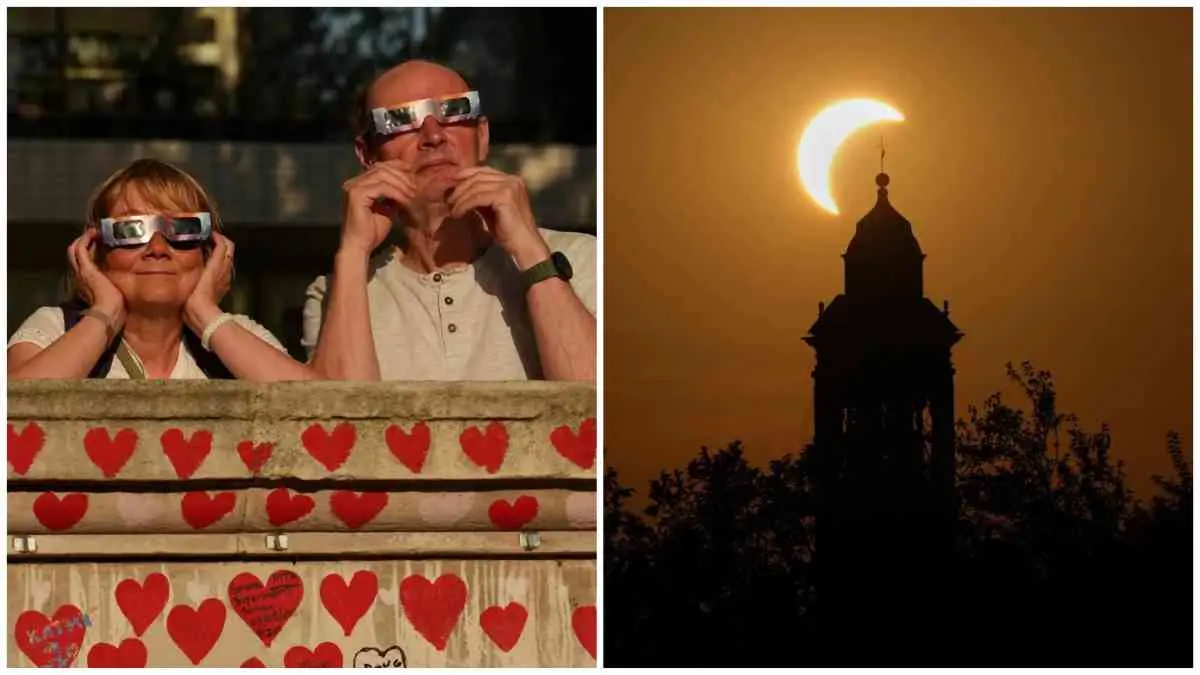

London: Millions of people across the United Kingdom and Europe gathered on hilltops, coastal bluffs, and city parks to witness a breathtaking astronomical spectacle as a rare solar eclipse swept across the region. The event marked Europe's most dramatic solar eclipse since 1999, casting a noticeable twilight dimness over the landscape as the Moon blocked out the vast majority of the Sun. For continuous updates on major global events and science news, visit our latest news portal.
A Dramatic 90% Obscuration Across Britain
Skywatchers in the United Kingdom experienced a deep partial solar eclipse, with the Moon covering between 90% and nearly 96% of the solar disc. The phenomenon reached its maximum peak shortly after 7:00 PM local time (BST), casting an unusual, eerie evening hue across major cities including London, Edinburgh, Manchester, and Cardiff.
Because the Moon crossed the Sun from right to left lower on the horizon, observers in the UK were treated to a distinct 'frown-shaped' crescent Sun—a rare sight that drew large crowds to popular vantage points like Primrose Hill in London and coastal areas in Cornwall, where coverage peaked at nearly 96%.
The Path of Totality Across Europe
While Britain witnessed a deep partial eclipse, a narrow corridor stretching across Greenland, Iceland, and Northern Spain experienced a total solar eclipse. In cities like Reykjavík, León, and Valencia, daylight briefly turned to complete darkness as the Moon completely covered the Sun, revealing the Sun's faint outer atmosphere—the solar corona. In Spain, the eclipse coincided with the setting Sun, creating a spectacular sunset totality that attracted hundreds of thousands of international tourists and astronomers.
Safe Viewing and Double Skywatching Bonus
With solar eclipse glasses selling out across high streets in the days leading up to the event, millions turned to certified solar viewers, pinhole projectors, and indirect optical techniques to safely observe the partial phases.
Astronomers noted that the timing of the eclipse coincided with the peak of the annual Perseid meteor shower. With the New Moon phase ensuring dark skies immediately following the eclipse, stargazers across Europe enjoyed a rare double celestial show late into the night.
Frequently Asked Questions
Ketan
adminPassionate journalist and digital news editor committed to delivering accurate, timely, and fact-checked news.
Related Articles




Latest Articles

Trump, Tech Giants Ink Voluntary AI Pact Amid Glob...
Oct 01, 2026
Khanna Targets 'Recursive' AI with Landmark Safety...
Oct 01, 2026
Election Commission–SIR Row: INDIA Bloc Announces...
Oct 01, 2026
WHO Unveils Critical Global Guidance to Combat Hea...
Oct 01, 2026
Comments (0)
Leave a Comment
No comments yet. Be the first to comment!