
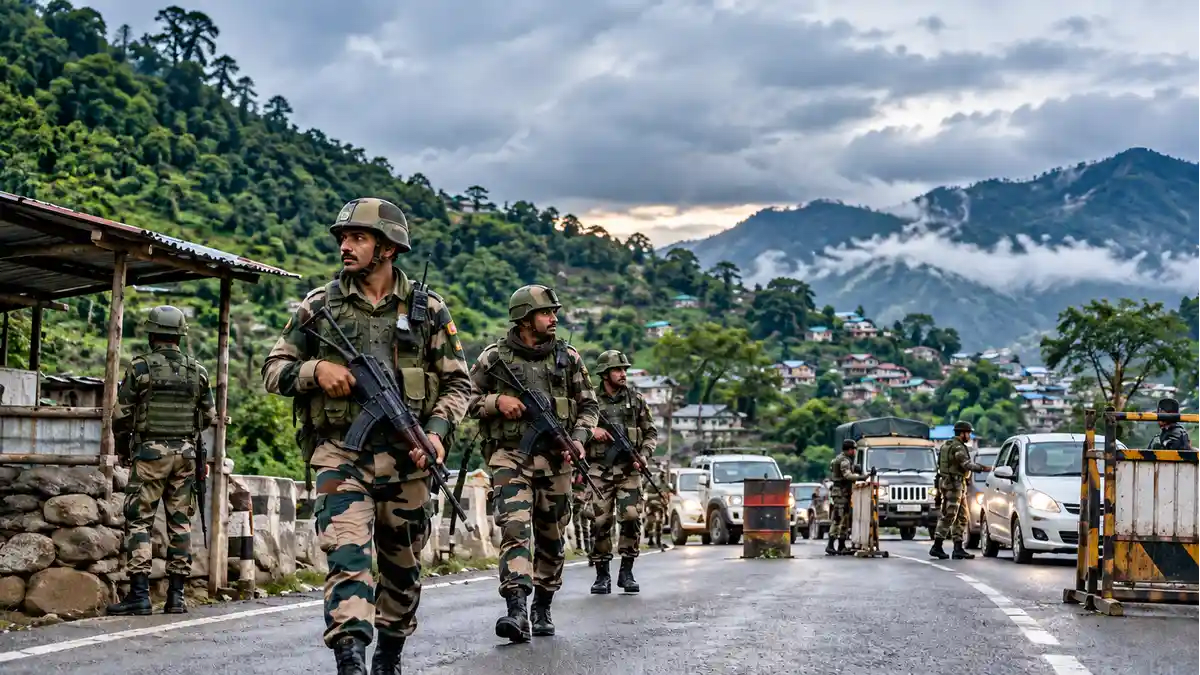

The Ministry of Home Affairs (MHA) has officially extended the Armed Forces (Special Powers) Act, 1958 (AFSPA) across designated parts of Manipur, Nagaland, and Arunachal Pradesh for an additional six months, effective from October 1, 2026, through March 31, 2027. The decision was formalized through statutory Gazette notifications issued by the Central Government following an extensive reassessment of the prevailing law-and-order and internal security dynamics across the three northeastern states.
Jurisdictional Coverage: What Has Changed Across the Three States?
The latest notification maintains the geographical status quo rather than implementing an expansive sweep or broad withdrawal. The legal demarcations across the three states are structured as follows:
- Manipur: The central notification retains the 'disturbed area' declaration across the vast majority of the state. However, the exemption continues for 13 police station jurisdictions spread across five valley districts: Imphal West, Imphal East, Thoubal, Bishnupur, and Kakching.
- Nagaland: AFSPA has been extended across nine whole districts: Dimapur, Niuland, Chumoukedima, Mon, Kiphire, Noklak, Phek, Peren, and Meluri. In addition, the notification covers specific jurisdictions under 21 police stations across five other districts: Kohima, Mokokchung, Longleng, Wokha, and Zunheboto.
- Arunachal Pradesh: The disturbed area designation remains active in three eastern districts—Tirap, Changlang, and Longding—alongside areas falling within the jurisdictions of Namsai, Mahadevpur, and Chowkham police stations in Namsai district along the interstate boundary with Assam.
"The Central Government, in exercise of the powers conferred by Section 3 of the Armed Forces (Special Powers) Act, 1958, has declared specified areas as disturbed areas after a comprehensive review of the security environment to assist civil administration," states the official Gazette order.
Statutory Powers and Section 3 of the AFSPA
The orders were invoked under Section 3 of the Armed Forces (Special Powers) Act, 1958, which empowers the Central Government or the Governor of a State to declare an entire state or specific administrative regions as a 'disturbed area' if civil administration requires the assistance of armed forces to maintain public order.
Once declared disturbed, the statute grants operational personnel of the armed forces special legal powers under Section 4 of the Act. These include powers to enter and search premises without a warrant, arrest individuals based on reasonable suspicion, and open fire after issuing due warning if necessary to maintain public order. These measures operate in tandem with civil police forces to curb insurgency networks, arms trafficking corridors, and organized ethnic strife.
Security Review and Contextual Dynamics
The decision to prolong the measure highlights persistent security considerations across border corridors and sensitive transit junctions in the Northeast. In Manipur, continuing political debates and public scrutiny over ethnic tensions remain active, with opposition figures like former Chief Minister O. Ibobi Singh voicing concern over ongoing violence and security postures. However, central security planners determined that maintaining the existing containment footprint is essential to safeguard key highways, inter-district boundaries, and logistical transit hubs.
Unless withdrawn earlier by subsequent government notification, the present extension will remain fully in effect until March 31, 2027.
Frequently Asked Questions
Ketan
adminPassionate journalist and digital news editor committed to delivering accurate, timely, and fact-checked news.
Related Articles



Latest Articles

Trump, Tech Giants Ink Voluntary AI Pact Amid Glob...
Oct 01, 2026
Khanna Targets 'Recursive' AI with Landmark Safety...
Oct 01, 2026
Election Commission–SIR Row: INDIA Bloc Announces...
Oct 01, 2026
WHO Unveils Critical Global Guidance to Combat Hea...
Oct 01, 2026
Comments (0)
Leave a Comment
No comments yet. Be the first to comment!