


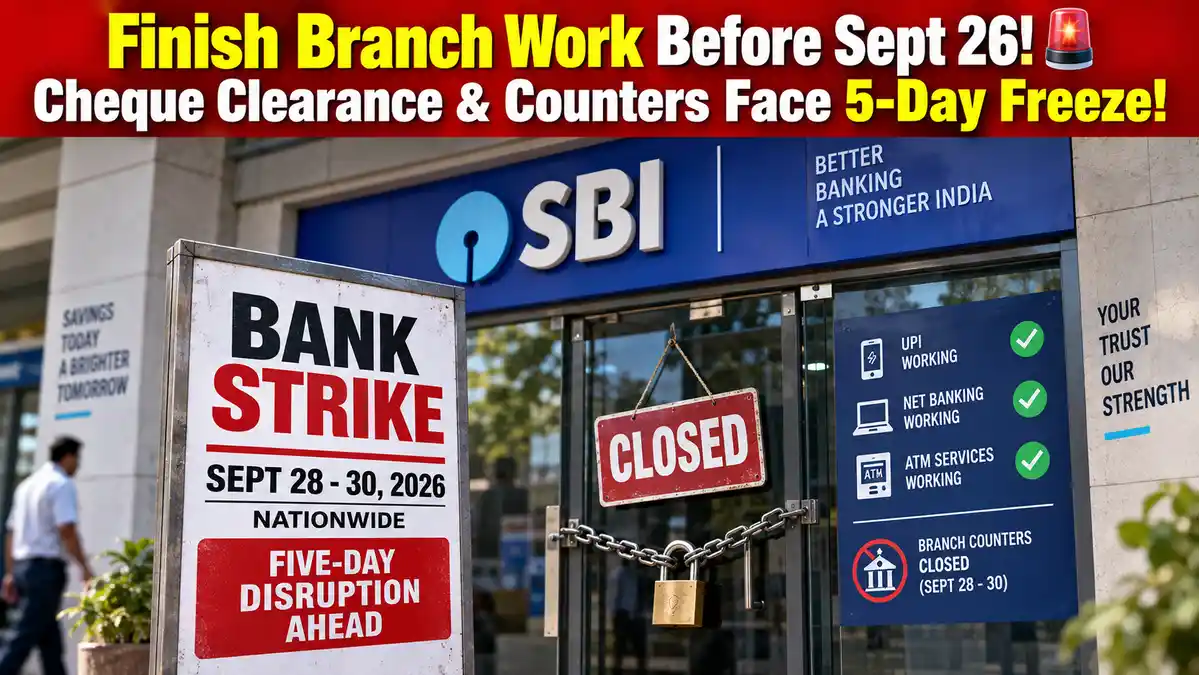
India's financial system witnessed a dual structural shock on Friday, September 11, as thousands of public sector bank branches were hit by an all-India strike while Dalal Street depositories initiated the formal freeze on unlisted shares of the National Stock Exchange (NSE).
Nationwide UFBU Bank Strike Paralyses Physical Operations
The United Forum of Bank Unions (UFBU)—an umbrella organization representing over nine major bank employees and officers unions—staged a nationwide walkout after conciliation proceedings with the Department of Financial Services (DFS) and the Indian Banks' Association (IBA) ended inconclusively. Major state-run lenders including the State Bank of India (SBI), Punjab National Bank (PNB), Bank of Baroda, and Union Bank of India experienced severe bottlenecks in physical cheque clearances, currency chests, and commercial trade document counters.
Because September 11 falls on a Friday ahead of the second Saturday and regular Sunday holidays—followed by regional closures for Ganesh festival celebrations—several states face a near four-day physical banking disruption.
"The five-day work week was mutually agreed upon in the 12th Bipartite Settlement and 9th Joint Note on March 8, 2024. Despite extending daily branch timings by 40 minutes to compensate, the Union Cabinet has delayed notification for over two years," a senior UFBU spokesperson stated.
Escalation Timeline: 3-Day Strike and Indefinite Walkout
Bank unions have outlined a multi-phase agitation schedule if the central government does not issue an official gazette notification on working hours:
- Phase 1 (September 11): Full-day nationwide physical branch and clearing house strike.
- Phase 2 (September 28, 29, and 30): Three-day consecutive pan-India banking shutdown.
- Phase 3 (October 26 onwards): Indefinite nationwide strike across all participating public and regional rural lenders.
Dalal Street Action: NSE Depository ISIN Freeze Enforced
Simultaneously, the National Stock Exchange executed a total freeze on its unlisted equity ISIN (INE721I01024) across National Securities Depository Limited (NSDL) and Central Depository Services Limited (CDSL). The mandate halts all unlisted secondary share trading, off-market transfers, and fresh pledge creations until the exchange's equity shares debut on the public trading floors.
Under the statutory mandates of the Securities and Exchange Board of India (SEBI) (ICDR) Regulations, securities offered in a public issue must be unencumbered and locked against off-market changes prior to allocation:
- Capital Table Freezing: Establishes a static pre-IPO cap table for domestic and foreign institutional shareholders.
- Offer for Sale (OFS) Ringfencing: Major institutional stakeholders, including Bank of Baroda and New India Assurance, have moved divestment blocks into pre-IPO escrow frameworks.
- Statutory Pre-IPO Lock-in: Unlisted retail and institutional holders will undergo SEBI's mandatory six-month post-listing lock-in from the official date of allotment.
Impact on Retail Customers and Unlisted Traders
While branch counters and clearing operations stalled, core digital payment rails—including UPI, IMPS, RTGS, internet banking, and standalone ATM networks—remained operational. SBI and PNB issued advisories directing customers to utilize Cash Deposit Machines (CDMs) and self-service digital portals for urgent transactions.
On Dalal Street, grey-market trading desks reported that unlisted transaction volumes for NSE shares dropped to zero overnight. High-net-worth investors and wealth funds holding pre-IPO units must now await primary allotment and listing day price discovery to access liquidity.
Frequently Asked Questions
Ketan
adminPassionate journalist and digital news editor committed to delivering accurate, timely, and fact-checked news.
Related Articles



Latest Articles

Trump, Tech Giants Ink Voluntary AI Pact Amid Glob...
Oct 01, 2026
Khanna Targets 'Recursive' AI with Landmark Safety...
Oct 01, 2026
Election Commission–SIR Row: INDIA Bloc Announces...
Oct 01, 2026
WHO Unveils Critical Global Guidance to Combat Hea...
Oct 01, 2026
Comments (0)
Leave a Comment
No comments yet. Be the first to comment!