
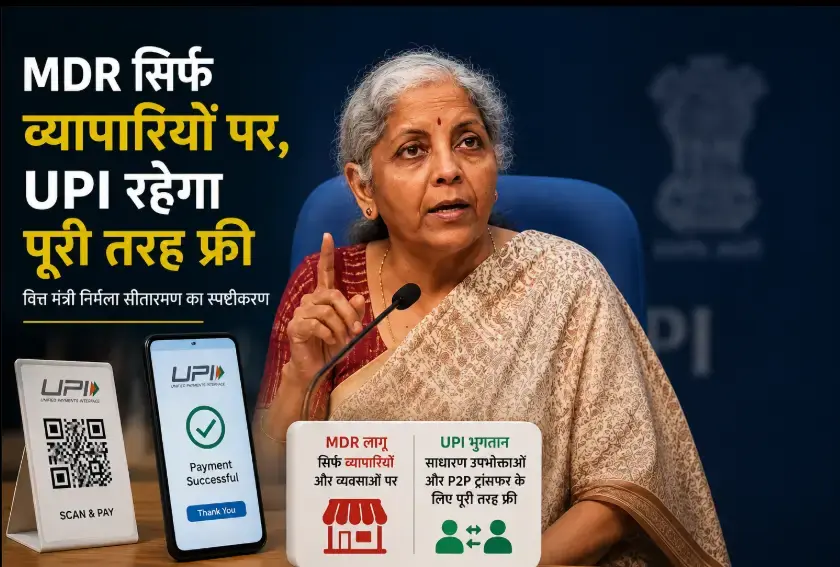

Union Finance Minister Nirmala Sitharaman clarified that any proposed Merchant Discount Rate (MDR) under the Taxation and Other Laws (Amendment) Bill, 2026 will apply exclusively to merchants and businesses, ensuring that UPI payments remain completely free for ordinary consumers and P2P transfers.
- FM Nirmala Sitharaman clarified that any proposed MDR on digital payments applies strictly to merchants, not consumers.
- Parliament passed the Taxation and Other Laws (Amendment) Bill, 2026, enabling a regulated fee structure for payment providers.
- Person-to-Person (P2P) money transfers will remain 100% free.
- MDR revenue will help banks and fintech firms invest in digital security, server capacity, and infrastructure.
- NPCI's steering committee will finalize the merchant fee rate structure after full enactment of the bill.
FM Nirmala Sitharaman Refutes Claims of Consumer UPI Charges
New Delhi: Union Finance Minister Nirmala Sitharaman has strongly dismissed reports and political allegations suggesting that ordinary citizens will have to pay for using the Unified Payments Interface (UPI). Responding to opposition claims, the Finance Minister clarified that any Merchant Discount Rate (MDR) introduced under recent legal amendments will apply strictly to commercial merchants and businesses, not end-users or consumers.
Taxation and Other Laws (Amendment) Bill, 2026 Passed
The clarification came after Parliament passed the Taxation and Other Laws (Amendment) Bill, 2026. The new legislation amends Section 10A of the Payment and Settlement Systems Act, 2007, removing the blanket statutory zero-MDR mandate enforced since 2020. The amendment grants the central government powers to notify specific electronic payment modes that will remain fee-exempt while enabling a structured fee model for commercial transactions.
MDR to Boost Banking and Fintech Infrastructure
Pushing back against Congress general secretary Jairam Ramesh's social media post claiming the bill paved the way for taxing ordinary digital payment users, FM Sitharaman stated on X (formerly Twitter) that MDR revenue is essential for maintaining the digital ecosystem. She noted that allowing a merchant-side fee will empower banks and payment service providers to invest heavily in cybersecurity, server infrastructure, and fintech innovation, ultimately benefiting all UPI users.
Proposed MDR Framework and Person-to-Person (P2P) Exemption
According to government sources and preliminary reports, the National Payments Corporation of India (NPCI) and the UPI Steering Committee will determine the final MDR framework after the bill's complete enactment. Key highlights of the proposed framework include:
- Zero Charge for Customers: Individual consumers making day-to-day payments or transfers will continue to pay ₹0.
- P2P Transfers Free: All Person-to-Person (P2P) money transfers will remain completely outside the ambit of any transaction charges.
- Merchant Transactions Above ₹2,000: Official deliberations suggest a potential MDR cap between 0.25% and 0.4% strictly on high-value business/merchant payments above ₹2,000.
The government reiterated that over 95% of routine daily UPI transactions—such as purchasing groceries, paying milk vendors, or hailing rides—will remain unaffected even if merchant-side MDR is operationalized.
Frequently Asked Questions
Admin
adminPassionate journalist and digital news editor committed to delivering accurate, timely, and fact-checked news.
Related Articles

Latest Articles
Chinese Rocket Failure: Long March 7A Explodes 85...
Aug 13, 2026
Millions Across UK and Europe Witness Dramatic Sol...
Aug 13, 2026
Colombia Earthquake: 7.4-Magnitude Quake Kills 132
Aug 11, 2026
Jharkhand Protest: Police Use Water Cannons in Ran...
Aug 10, 2026
Comments (0)
Leave a Comment
No comments yet. Be the first to comment!