
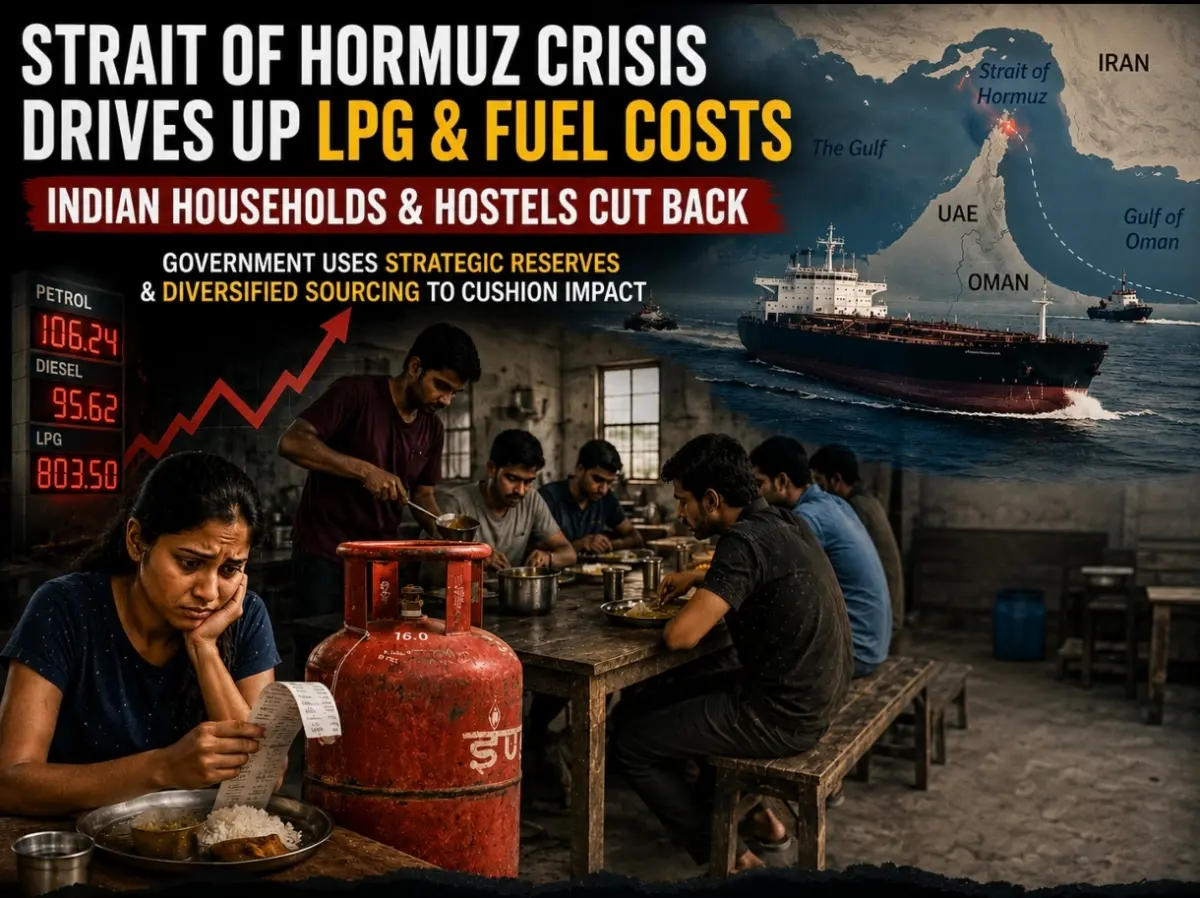

A Crisis Thousands of Kilometres Away, Felt at the Dinner Table
Across Indian cities, households, hostels, and small food vendors are feeling the squeeze of a conflict unfolding thousands of kilometres away in the Persian Gulf. As tensions between the US and Iran have escalated around the Strait of Hormuz, cooking gas has become harder to procure and more expensive, forcing many families to quietly scale back their meals and daily spending.
Why the Strait of Hormuz Matters So Much to India
Almost 88 percent of India's crude oil needs are imported, with nearly half transiting through the Strait of Hormuz. The exposure is even sharper for cooking gas: around 60 percent of India's household LPG and a substantial share of its LNG supplies from Gulf producers including Saudi Arabia, Iraq, UAE, Kuwait, Qatar, and Iran pass through this single chokepoint. When the strait is disrupted, the effects ripple quickly from shipping lanes into Indian kitchens.
LPG Prices Have Climbed Sharply Since February
Since February 2026, the Saudi Contract Price that benchmarks India's LPG import costs has risen nearly 46 percent, from about $543 per tonne to roughly $790 per tonne by June. The government raised domestic LPG cylinder prices by Rs 29 in one recent adjustment, taking a 14.2 kg cylinder from Rs 913 to Rs 942, the second such increase within three months, adding up to a Rs 89 rise for the year. Officials note that Indian households still pay considerably less than consumers in Pakistan, Nepal, Bangladesh, Sri Lanka, and Western countries, thanks to government-absorbed under-recovery costs.
Renewed Closure Adds Fresh Pressure
Fresh US strikes on Iran and Iran's declared closure of the Strait of Hormuz on July 11 have again clouded the supply outlook, even as Indian officials say the country is better prepared than during the earlier phase of the conflict. Only six vessels transited the strait on Sunday, the lowest in five months, according to shipping data. Union Petroleum Minister Hardeep Singh Puri has said India holds 60 days of crude oil stock, 60 days of LNG inventory, and 45 days of LPG inventory, giving the country a buffer against short-term disruption. Brent crude climbed to around $79 a barrel amid the renewed tensions, its highest level since June 19.
The Human Impact: Smaller Meals, Fewer Curries
The disruption is playing out in ordinary routines. In one Delhi hostel, residents noticed chicken and fried rice disappear from the menu, replaced by a single curry with rice, after the hostel owner cited LPG shortages and rising costs. Many households have turned to electric induction stoves to reduce cylinder consumption, while some families have cut back on personal vehicle use as petrol prices rise in tandem with crude.
Government Response and Longer-Term Measures
To cushion the impact, the government raised domestic LPG production by more than 60 percent, widened sourcing to non-Gulf suppliers including the United States, Canada, and Algeria, and tightened anti-diversion enforcement to prevent subsidised domestic LPG from leaking into the commercial market. Ujjwala Yojana beneficiaries receive an additional Rs 300 per cylinder credited directly to their bank accounts, reaching more than 10.58 crore connections. The Union Cabinet has approved Rs 30,000 crore in compensation to public sector oil marketing companies to help absorb the under-recovery.
What Comes Next
With Iran having formed a new Persian Gulf Strait Authority to assert control over shipping through Hormuz, and fresh US strikes continuing into this week, analysts expect further volatility in energy prices in the near term. For Indian households, the coming weeks will determine whether recent price increases prove temporary or become the new normal for cooking gas and fuel costs.
Frequently Asked Questions
Ketan
adminPassionate journalist and digital news editor committed to delivering accurate, timely, and fact-checked news.
Related Articles

Latest Articles

Trump, Tech Giants Ink Voluntary AI Pact Amid Glob...
Oct 01, 2026
Khanna Targets 'Recursive' AI with Landmark Safety...
Oct 01, 2026
Election Commission–SIR Row: INDIA Bloc Announces...
Oct 01, 2026
WHO Unveils Critical Global Guidance to Combat Hea...
Oct 01, 2026
Comments (0)
Leave a Comment
No comments yet. Be the first to comment!