
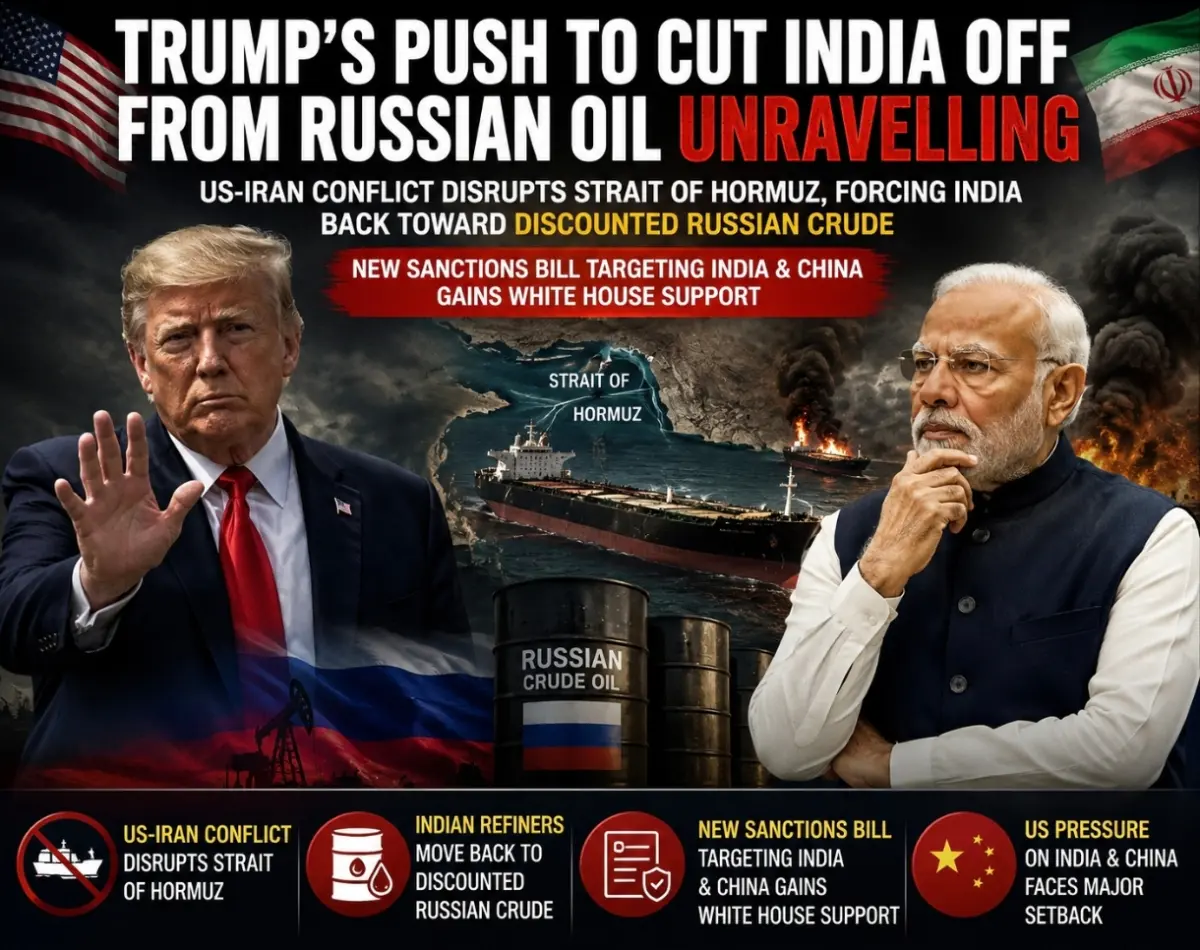

A Pressure Campaign Undone by Its Own Side Effects
For much of the past year, Washington pursued a sustained campaign to cut off one of Russia's most loyal oil customers: India. Under President Donald Trump, the US imposed a 25 percent secondary tariff on Indian goods specifically to punish New Delhi for its Russian crude purchases, later easing that levy from 50 percent to 18 percent after Indian refiners sharply reduced Russian oil imports in favour of Middle Eastern supplies. But the very conflict Trump has waged against Iran has now undercut that success.
Strait of Hormuz Disruption Reverses India's Pivot
The joint US-Israeli offensive against Iran effectively disrupted the Strait of Hormuz, the narrow waterway through which almost all Middle Eastern oil bound for India flows. According to Kpler data, Indian refiners had cut Russian crude imports from roughly 1.84 million barrels per day in November 2025 to about 1.04 million barrels per day by February 2026. That pullback has since reversed, with Russian oil accounting for roughly 47 percent of India's total crude imports by March, as refiners returned to Moscow to fill the supply gap left by the Hormuz disruption.
Treasury Grants Temporary Relief, Then Lets It Lapse
A temporary US Treasury general license had allowed Indian purchases of Russian crude without triggering sanctions, but that license expired on June 17, 2026. US Treasury Secretary Scott Bessent acknowledged the bind India faced, telling Fox Business that Washington had "given India permission to accept the Russian oil" to ease the temporary global supply gap and that the US "may unsanction other Russian oil."
India's Own Comfort Cushion
Despite the disruption, Indian officials have downplayed the immediate risk to supply. An oil ministry source told CNN that India maintains around 25 days of crude oil inventory and roughly 25 days of petrol and diesel inventory, giving it a total cover of nearly eight weeks of crude oil and petroleum products. "We are going to ramp up our supplies from other parts of the geographies and make up for our supply crunch from the Straits of Hormuz," the source said.
New Sanctions Threat Looms Over China and India
Adding further pressure, a Russia oil sanctions bill has reportedly won White House support, with proposed secondary tariffs targeting China and India, which together absorb more than 80 percent of Russia's seaborne crude exports. Senator Lindsey Graham, a key sponsor of the bill, cited Ukraine's recent battlefield gains and softening global oil prices as factors that made the timing more favourable, though the legislation's fate remains uncertain with the Senate's limited calendar before its August 1 recess.
The Bigger Picture for India
The episode illustrates the difficulty of squaring two of Washington's competing objectives: choking off Russian oil revenue while managing the fallout of an active war in the world's most important oil transit chokepoint. For India, caught between US pressure and its own energy security needs, the coming weeks will likely determine whether its Russian oil pullback becomes permanent or is repeatedly overridden by geopolitical shocks beyond its control.
Frequently Asked Questions
Ketan
adminPassionate journalist and digital news editor committed to delivering accurate, timely, and fact-checked news.
Related Articles

Latest Articles

Trump, Tech Giants Ink Voluntary AI Pact Amid Glob...
Oct 01, 2026
Khanna Targets 'Recursive' AI with Landmark Safety...
Oct 01, 2026
Election Commission–SIR Row: INDIA Bloc Announces...
Oct 01, 2026
WHO Unveils Critical Global Guidance to Combat Hea...
Oct 01, 2026
Comments (0)
Leave a Comment
No comments yet. Be the first to comment!