


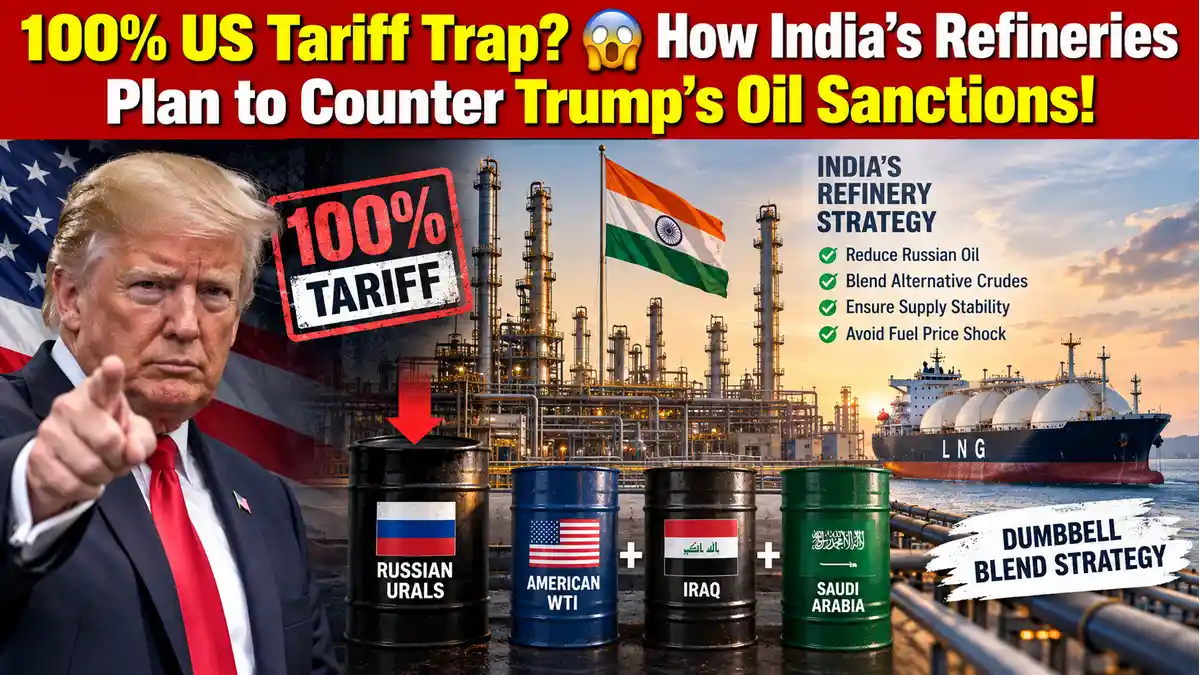
President Donald Trump has officially signed into law the bipartisan Lindsey O. Graham Sanctioning Russia and Iran Act of 2026 after clearing the U.S. House of Representatives (262–159) and the Senate (86–11). The statute arms the White House with discretionary authority under Section 113 to impose additional ad valorem duties of up to 100% on goods originating from the five largest sovereign importers of Russian crude oil and natural gas. With Russian crude accounting for nearly 50% of India's seaborne petroleum imports—worth $40.8 billion in FY2026—New Delhi's key export sectors face unprecedented pricing challenges as the statutory 30-day evaluation clock begins.
The Statutory Trigger: Section 113 & The 'Top-Five Importer' Rule
Under Section 113 of the Act, the executive branch must assess major sovereign buyers within 30 days of enactment. The statute targets foreign jurisdictions that knowingly execute commercial contracts for Russian petroleum or natural gas and rank among the five largest global importers by volume over the preceding 12-month trailing cycle.
The legislation gives the Office of the United States Trade Representative (USTR) statutory discretion to calibrate secondary tariff rates between 0% and 100%. The USTR will review the top-five importer registry every 180 days, tying potential tariff rollbacks to whether target nations deliver verifiable volumetric reductions in Russian hydrocarbons. The U.S. President retains the right to issue a national interest waiver by certifying to Congress that broad tariff enforcement harms American economic security, providing a durable Congressional mandate insulated from judicial challenges.
New Delhi's Strategic Energy Dilemma & Sovereign Stance
Data compiled by independent energy tracker Kpler indicates Indian refiners processed approximately 2.96 million barrels per day of discounted Urals and Russian grades by mid-2026, substantially reducing the market share of traditional Middle Eastern crude. Industry analysts have stressed that abruptly substituting these discounted volumes without triggering domestic inflationary shocks remains structurally difficult.
The Ministry of External Affairs (MEA) reiterated that India's hydrocarbon procurement strategy is driven strictly by national energy security imperatives for its 1.4 billion population and plays an essential role in stabilizing global petroleum benchmarks. Indian diplomats noted that penalizing value-added petroleum derivatives from Indian refineries would tighten global diesel and aviation turbine fuel supplies.
Downstream Market Repercussions: Pharma, Textiles & Waivers
India supplies approximately 40% of all generic prescription pharmaceuticals consumed within the U.S. healthcare network. Punitive secondary tariffs would likely push up drug acquisition costs for American providers while squeezing margins for Indian pharmaceutical manufacturers listed on the National Stock Exchange (NSE).
Similarly, labor-intensive ready-made garment clusters in Tiruppur and Surat—operating on net operating margins of 8% to 12%—face potential order diversion to Southeast Asian competitors if reciprocal tariffs take effect. In response, officials from the Ministry of Commerce and Industry are initiating bilateral consultations with Washington, exploring expanded imports of U.S. West Texas Intermediate (WTI) crude and long-term liquefied natural gas (LNG) contracts to fulfill statutory waiver conditions under Section 113(d).
Frequently Asked Questions
Ketan
adminPassionate journalist and digital news editor committed to delivering accurate, timely, and fact-checked news.
Related Articles


Latest Articles

Trump, Tech Giants Ink Voluntary AI Pact Amid Glob...
Oct 01, 2026
Khanna Targets 'Recursive' AI with Landmark Safety...
Oct 01, 2026
Election Commission–SIR Row: INDIA Bloc Announces...
Oct 01, 2026
WHO Unveils Critical Global Guidance to Combat Hea...
Oct 01, 2026
Comments (0)
Leave a Comment
No comments yet. Be the first to comment!