
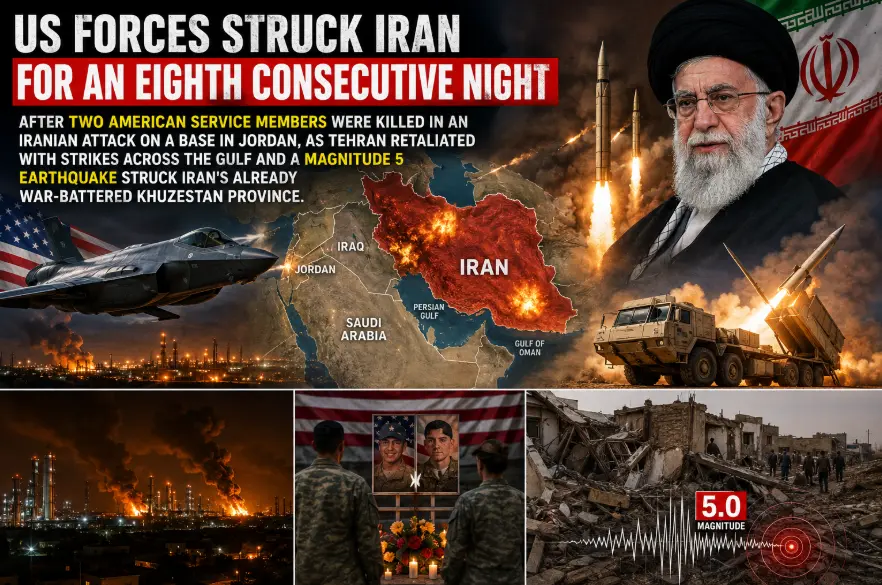

US forces struck Iran for an eighth consecutive night after two American service members were killed in an Iranian attack on a base in Jordan, as Tehran retaliated with strikes across the Gulf and a magnitude 5 earthquake struck Iran's already war-battered Khuzestan province.
- US forces struck Iran for an eighth consecutive night after two service members were killed in Jordan.
- A third US service member remains missing following the Jordan attack.
- Iran retaliated with strikes on a Kuwaiti power plant and shot down a US drone over Ahvaz.
- A magnitude 5 earthquake struck Iran's Khuzestan province on Sunday, with no casualties reported so far.
- Iranian officials have warned of 'full-scale' escalation if US strikes continue.
Eighth Consecutive Night of US Strikes on Iran
US Central Command (CENTCOM) carried out an eighth consecutive night of airstrikes against Iran on Saturday, following the deaths of two American service members in an Iranian attack on a military base in Jordan two days earlier. CENTCOM said the strikes were ordered by President Donald Trump to "swiftly punish" Islamic Revolutionary Guard Corps (IRGC) forces believed responsible for the Jordan attack, while continuing to degrade Iran's ability to threaten commercial shipping in the Strait of Hormuz.
Two Killed, One Missing in Jordan
CENTCOM said two US service members were killed in action while defending against an Iranian ballistic missile and drone attack in Jordan on Friday, with a third service member still listed as missing. Four other personnel were medically evacuated to hospitals in Jordan but have since been discharged, while others evaluated for minor injuries have returned to duty. CENTCOM said it was withholding the identities of the two service members killed until 24 hours after their families were notified. The deaths add to 14 other US service members killed in action since the broader conflict began following US and Israeli strikes on Iran on February 28.
What US Forces Targeted
CENTCOM said the latest round of strikes, conducted using fighter jets, aerial drones and warships, hit "Iranian military coastal surveillance and air defense facilities, maritime capabilities, and missile and drone storage sites." More than 50,000 US military personnel remain deployed across the Middle East and are on heightened alert as the conflict continues. Separately, the International Atomic Energy Agency said Sunday it was investigating reports of an overnight strike on the construction site of Iran's planned Darkhovin nuclear power plant.
Trump's Response
President Trump called the deaths of the two service members "a very sad thing" in a brief phone call, saying the troops died "in service of our country" and reiterating that the war's central objective remains "never allowing Iran to have a nuclear weapon."
Iran Retaliates Across the Gulf
Iran has continued striking US-linked and allied targets across the region in response. Kuwaiti authorities said an Iranian attack caused a fire at a power and water distillation plant for the second consecutive day on Sunday, which Kuwait's electricity and water ministry described as "heinous Iranian aggression." The IRGC also claimed responsibility for shooting down a US MQ-9 drone over Ahvaz in Khuzestan province using its own air defense systems. The US Embassy in Jordan separately announced the evacuation of Aqaba's international airport and seaport over what it called a "specific and credible threat," urging Americans to avoid both locations.
Iranian Officials Warn of Escalation
Mohsen Rezaei, an adviser to Iran's Supreme Leader Mojtaba Khamenei, warned on Sunday that if US strikes continue for another two to three days, Iran would move to a stage of "full-scale invasion and annihilation," adding that Iran would no longer limit itself to retaliation in kind and that "no political border will provide security against Iran's offensive forces." Separately, Khamenei said repeated US attacks had shown that Trump's signature on last month's ceasefire memorandum of understanding was "utterly worthless and devoid of credibility."
Magnitude 5 Earthquake Strikes Khuzestan
Amid the ongoing military escalation, a magnitude 5 earthquake struck Iran's Saland area in the southwestern Khuzestan province early Sunday morning, according to Iran's Red Crescent Society. The quake, which occurred at a depth of about 12 kilometres near Andimeshk, was felt across parts of southwestern Iran, southeastern Iraq, and Kuwait. No casualties have been reported so far. Khuzestan Governor Seyed Mohammad Reza Mowlaizadeh said he had ordered the full mobilisation of rescue and operational forces, with two Red Crescent teams dispatched to assess damage in villages near the epicentre. Khuzestan, Kermanshah, and Hormozgan are among Iran's most seismically active provinces due to their location along the Zagros fault system, though the quake's timing amid ongoing US strikes in the same region has drawn heightened international attention.
What's Next
With a fragile ceasefire from last month now effectively collapsed and both sides continuing to trade strikes across the Gulf, the conflict shows no clear sign of near-term resolution. US officials say they are evaluating further Iranian military targets, while Iranian officials continue to warn of broader retaliation should the American strikes continue.
Frequently Asked Questions
Admin
adminPassionate journalist and digital news editor committed to delivering accurate, timely, and fact-checked news.
Related Articles




Latest Articles

E20 Janta Party: New Online Movement Demands Pure...
Jul 28, 2026
Anti-Paper Leak Bill Tabled in Lok Sabha, Debate o...
Jul 28, 2026
Nvidia in Talks for $250 Billion OpenAI Data Cente...
Jul 27, 2026
Mirabai Chanu Wins Historic Third Straight CWG Gol...
Jul 27, 2026
Comments (0)
Leave a Comment
No comments yet. Be the first to comment!